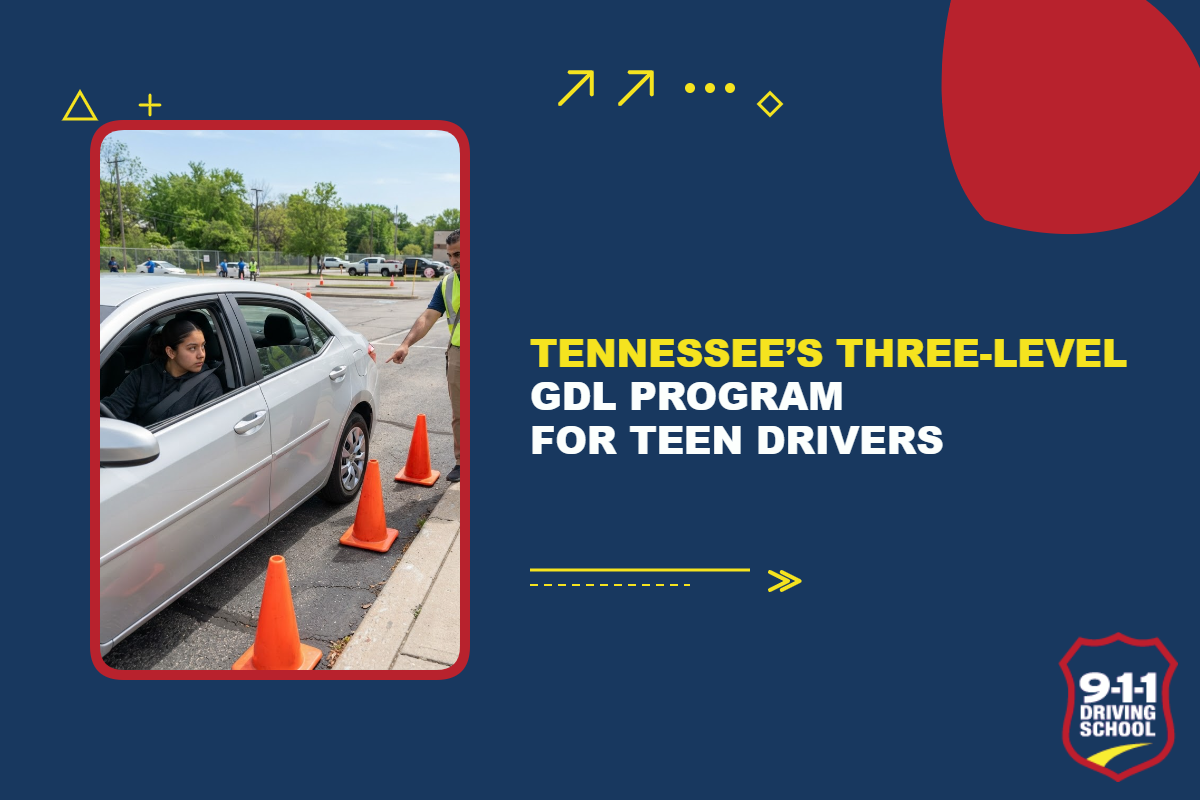
Tennessee’s three-level GDL program for teen drivers
Getting a driver’s license is a major milestone for Tennessee teens, but it does not happen all at once. The state uses a graduated driver license system, often called GDL, to help new drivers build skill and judgment before they receive full driving privileges.
For most families, the process moves through three main teen license levels: the learner permit, the intermediate restricted license and the intermediate unrestricted license. A regular Class D license comes later, usually at age 18 or when the teen graduates from high school or earns a GED, whichever happens sooner.
This guide explains how Tennessee’s Teen/Graduated Driver License program works, what parents should track, what restrictions apply at each level and how teens can use each stage to become safer, more confident drivers.
Quick overview of Tennessee’s teen GDL levels
Tennessee’s GDL program is a step-by-step licensing system. The official Tennessee overview of issued driver licenses describes the program as a tiered process designed to help young drivers develop skills as they ease into driving privileges.
Here is the basic structure:
- Level 1 learner permit: for drivers who are at least 15 years old, pass the written knowledge test and vision screening, and drive only with a properly licensed supervising driver in the front seat.
- Level 2 intermediate restricted license: for drivers who are at least 16, have held a valid learner permit for at least 180 days, complete 50 hours of behind-the-wheel practice including 10 hours at night, and pass the road skills test.
- Level 3 intermediate unrestricted license: for drivers who are at least 17, have held the intermediate restricted license for one year, and meet the required safe-driving conditions.
- Regular Class D license: available when the driver turns 18 or graduates from high school or earns a GED, whichever is sooner, as long as other requirements are met.
The details matter. A teen can be old enough for the next level but still delayed by missing practice hours, an unsigned form, too many points, an at-fault crash or a seat belt violation.
Why Tennessee uses a graduated driver license system
Teen drivers are still learning how to manage risk. They are building habits for scanning intersections, judging gaps, controlling speed, driving at night, handling passengers and staying focused when conditions change.
A graduated license system gives parents and teens a clear path. Instead of handing a new driver full privileges immediately, Tennessee adds freedom in stages. The early stage requires direct supervision. The next stage allows independent driving with limits. The final teen stage removes many restrictions, but still keeps the driver under the intermediate license structure until the regular license is available.
Families can also review Tennessee teen driver safety guidance from the Tennessee Highway Safety Office for a plain-language summary of the state’s teen driving rules, including seat belt, passenger, nighttime and cell phone restrictions.
Level 1: learner permit
The learner permit is the first step for most Tennessee teens. It gives the teen permission to practice driving, but only under supervision and only within the permit restrictions.
A teen should not think of the learner permit as a waiting period. It is the most important practice stage in the entire process. The habits built here will affect the road skills test, the first months of independent driving and the teen’s readiness for higher-risk situations like nighttime driving, traffic congestion and rural roads.
Basic learner permit requirements
According to the official Tennessee Teen/Graduated Driver License page, a teen must be at least 15 years old and pass the standard written exams and vision screening to qualify for the learner permit.
The applicant should also study the Tennessee Driver License Manual before taking the knowledge test. The manual covers road signs, signals, lane markings, right-of-way, speed, safe driving practices and other subjects that new drivers need to know before driving on public roads.
Common learner permit requirements include:
- Be at least 15 years old.
- Pass the knowledge test.
- Pass the vision screening.
- Have a parent or legal guardian complete the required minor affidavit.
- Provide proof of school attendance or graduation status when required.
- Provide the required identity, legal presence, Social Security number and Tennessee residency documents.
Learner permit restrictions
A Tennessee learner permit holder must drive with a licensed driver who is at least 21 years old and seated in the front seat. The permit holder may not drive between 10 p.m. and 6 a.m., and the driver and passengers must wear safety belts.
Tennessee also restricts cell phone use for young drivers. The state’s teen driver safety guidance summarizes the rule as prohibiting all cell phone use for teen drivers in the learner permit and intermediate stages.
For parents, the key is consistency. A learner permit is not permission for a teen to drive around the block alone, move a vehicle without supervision or run a quick errand before a licensed adult gets in the car.
Online knowledge test option
Tennessee allows eligible applicants ages 15 to 17 to take the knowledge test online under the supervision of a parent or legal guardian. Families should review the official Tennessee online knowledge permit test requirements before using this option.
The online test is convenient, but it is still a formal state exam. Applicants should prepare the testing space, follow the technology requirements and avoid any help, notes or distractions during the test.
The state lists the online test as 30 questions, with 60 minutes to complete it and a minimum passing score of 80 percent. If a family chooses the online option, the parent or legal guardian serving as proctor must follow the Tennessee Proctor ID process.
Documents families need for the first license step
Paperwork is one of the most common causes of delays for teen drivers. A student may be ready for the test but still unable to complete the process if a form is missing, unsigned, expired or not an original document when an original is required.
Tennessee’s minor/teenage affidavit and proof of school attendance requirements explain that a teen applicant must have a Minor/Teenage Affidavit and Cancellation form. The adult signing the form accepts financial responsibility for the minor driver.
Applicants under 18 must also prove school enrollment or provide proof of graduation. If a school attendance form is required, families should pay attention to the date because the state notes that the form is valid for only 30 days.
The Tennessee forms and publications page includes GDL-related forms such as the 50-hour driving certificate, the minor/teenage affidavit and the compulsory school attendance form.
Before visiting a Driver Services Center, families should gather:
- Proof of identity and date of birth.
- Proof of U.S. citizenship or lawful permanent resident status, when applicable.
- Social Security number documentation or acceptable alternative documentation.
- Two acceptable proofs of Tennessee residency.
- Minor/Teenage Affidavit and Cancellation form.
- School attendance form or proof of graduation, when required.
- Any pre-approval documents or testing receipts, if the family used the online process.
Families should always check the current state page before the appointment because document requirements can change and photocopies may not be accepted.
How to use the 180-day learner permit period
A teen must hold the learner permit for at least 180 days before moving to the intermediate restricted license. That time should be used intentionally.
The next step requires 50 hours of behind-the-wheel driving experience, including 10 hours at night. A parent, guardian or licensed driving instructor must certify those hours on the Tennessee 50-hour behind-the-wheel certification form.
A useful practice plan should include more than easy neighborhood loops. New drivers need repeated exposure to different traffic conditions so they learn how to make decisions instead of simply following a memorized route.
During the learner permit period, teens should practice:
- Starting, stopping and turning smoothly.
- Parking, backing and low-speed vehicle control.
- Full stops at stop signs and red lights.
- Right-of-way decisions at four-way stops and uncontrolled intersections.
- Left turns across traffic.
- Lane changes with mirror checks, signals and blind-spot checks.
- Speed control on two-lane roads and multilane roads.
- Following distance in normal traffic and poor weather.
- Night driving with reduced visibility.
- Rain, glare, hills, curves and rural roads when conditions are safe.
Parents should keep the practice log current instead of trying to reconstruct it right before the road skills test. Waiting until the last minute can lead to mistakes, missing night hours or a certification that does not accurately reflect the teen’s experience.
A practical 50-hour driving plan for Tennessee families
The 50-hour requirement should feel like a training plan, not a box to check. A teen who completes all 50 hours in the same neighborhood may still struggle with traffic, merging, higher speeds or nighttime driving.
Here is one way to organize the practice period:
- Hours 1 to 5: basic vehicle control in a quiet area. Practice smooth starts, stops, turns, parking, steering recovery and mirror use.
- Hours 6 to 15: residential streets. Add stop signs, right turns, left turns, scanning for pedestrians and basic right-of-way decisions.
- Hours 16 to 25: moderate traffic. Practice lane position, following distance, speed control, traffic lights and busier intersections.
- Hours 26 to 35: multilane roads and route planning. Work on lane changes, choosing the correct lane early and responding to construction or traffic backups.
- Hours 36 to 40: nighttime driving. Begin with familiar roads, then add intersections, glare, reduced visibility and parking lot awareness.
- Hours 41 to 50: test readiness and real-world judgment. Combine parking, backing, intersections, lane changes, curves, rural roads and higher-speed driving.
Not every teen progresses at the same pace. A driver who needs more time with turns, speed control or lane changes should spend extra time there before moving to harder traffic situations.
Level 2: intermediate restricted license
The intermediate restricted license is the first major step toward independent driving. It gives a teen more freedom than the learner permit, but it still includes important limits.
To reach this level, the teen must be at least 16 years old, hold a valid learner permit for at least 180 days, complete the required supervised driving hours and pass the road skills test.
Requirements for the intermediate restricted license
The official Tennessee Teen/Graduated Driver License requirements list the main requirements for the Level 2 intermediate restricted license.
A teen generally must:
- Be at least 16 years old.
- Have held a valid learner permit for a minimum of 180 days.
- Complete 50 hours of behind-the-wheel driving experience.
- Complete at least 10 of those hours at night.
- Have the 50-hour certification signed by a parent, guardian or driving instructor.
- Pass the road skills test.
- Avoid accumulating six or more points during the 180 days immediately before applying.
The teen should also arrive at the road skills test with an accompanying licensed driver who is at least 21 years old. Tennessee notes that a permit holder who arrives without the required licensed driver will not be allowed to proceed with the test.
Intermediate restricted license driving limits
The Level 2 license allows more independence, but it is not the same as a full license.
At this stage, a teen generally may have only one passenger in the vehicle and may not drive between 11 p.m. and 6 a.m. Seat belt rules still apply, and cell phone use remains prohibited for teen drivers under the GDL rules.
There are limited exceptions in state law for certain situations, such as being accompanied by a parent or legal guardian, driving with a properly designated licensed adult, or traveling to and from certain school or work activities with written permission. Families should review the current Tennessee Code section on learner permits and intermediate licenses or contact Tennessee Driver Services before relying on an exception.
Parents should treat these limits as part of the training process. The first months of independent driving are not the time to add late-night driving, a car full of friends or phone distractions.
Preparing for the Tennessee road skills test
The road skills test is the point where the state evaluates whether the teen can control the vehicle, follow traffic laws and make safe decisions without constant coaching.
Families can use Tennessee Driver Services appointments and locations to find Driver Services Centers and appointment information. The state encourages road skills test appointments, and some locations may not be able to provide a test without one.
Before the test, the teen should be comfortable with:
- Adjusting the seat and mirrors.
- Using turn signals at the right time.
- Coming to complete stops.
- Looking left, right and ahead before entering intersections.
- Checking mirrors and blind spots before lane changes.
- Maintaining lane position through curves and turns.
- Controlling speed without repeated hard braking.
- Yielding to pedestrians, bicyclists and other vehicles when required.
- Backing and parking safely.
- Responding calmly to instructions.
A teen who can pass a test route only after repeated coaching probably needs more practice. During the final weeks before the road skills test, parents should reduce coaching and let the teen make decisions while still intervening when safety requires it.
Road test day reminders
On test day, arrive early and bring the required documents. The vehicle should be legally registered, properly insured and in safe operating condition.
The teen should know how to operate the headlights, turn signals, brake lights, wipers, defroster, hazard lights, parking brake and other basic controls. Do not use an unfamiliar vehicle without practicing in it first.
Parents should confirm fees before the visit by checking the current Tennessee driver license fees page or the appointment information provided by Driver Services.
Level 3: intermediate unrestricted license
The intermediate unrestricted license is the third teen GDL level. It removes many of the limits that apply to the intermediate restricted license, but it is still part of the teen licensing pathway.
To apply for the intermediate unrestricted license, the teen must be at least 17 years old and must have held the intermediate restricted license for one year.
The teen must also meet safe-driving conditions. Tennessee states that the driver cannot have accumulated more than six points, cannot have had an at-fault traffic accident and cannot have two safety belt violations. No additional test is required for this step.
This level should not be treated as permission to ignore the habits developed earlier. Parents should continue discussing seat belts, passengers, phone use, speed, fatigue and nighttime driving, especially during the first year after the teen begins driving more independently.
Moving from GDL to a regular Class D license
The teen GDL program eventually leads to a regular Class D driver license. A regular Class D license is the standard license used to operate a passenger vehicle.
Tennessee explains that a driver may obtain a regular Class D license at age 18, or when the driver graduates from high school or receives a GED, whichever is sooner. At that point, the word intermediate is removed from the license, although under-21 indicators may still remain.
Families should review the current Tennessee regular driver license information when the teen is ready to move out of the intermediate license stage.
Common mistakes that delay Tennessee GDL progress
Most GDL delays are preventable. They usually happen because families misunderstand a timing rule, forget a form or treat a restriction as optional.
Counting the 180 days incorrectly
The learner permit must be held for at least 180 days before moving to the intermediate restricted license. Mark the eligible date on a calendar, but also remember that age, practice hours, driving record and paperwork still matter.
Forgetting the 10 hours of night driving
Tennessee requires 50 hours of behind-the-wheel practice, including 10 hours at night, before the Level 2 license. Families should schedule nighttime practice gradually instead of trying to finish all 10 hours right before the road test.
Showing up without the signed 50-hour certificate
The state requires a signed certification of the supervised driving hours. Download the current 50-hour behind-the-wheel driving experience form before the appointment and complete it carefully.
Ignoring passenger and nighttime restrictions
The Level 2 license has limits for passengers and late-night driving. A teen who treats the intermediate restricted license like a full license risks a violation and may delay progress toward the next stage.
Using a phone while driving
Tennessee’s teen driver safety materials emphasize that all cell phone use is prohibited for teen drivers in the learner permit and intermediate stages. The safest family rule is simple: the phone is silenced, put away and not handled while the vehicle is moving.
Letting points or violations interrupt the timeline
Points, at-fault crashes and seat belt violations can affect eligibility for the next level. Parents should use any warning sign as a reason for more practice, not just as a legal issue.
Waiting too long to check forms
Some forms and document rules are time-sensitive. The school attendance form, for example, should be checked close to the appointment date so it does not expire before the visit.
Parent tips for each GDL stage
Parents play a major role in Tennessee’s GDL system. The state requires parent or guardian involvement in the process, but the most important work happens during ordinary practice drives.
During the learner permit stage
- Keep the first sessions short and calm.
- Choose practice routes that match the teen’s current skill level.
- Give instructions early, not at the last second.
- Focus on one or two skills per drive.
- Track hours immediately after each practice session.
- Add night driving gradually once basic skills are consistent.
During the intermediate restricted stage
- Set written family rules for passengers, curfew, phone use and seat belts.
- Review each trip before the teen leaves, especially if the route is new.
- Keep practicing in rain, darkness and unfamiliar areas when it is safe to do so.
- Treat close calls as teaching moments.
- Do not allow exceptions to become daily habits.
During the intermediate unrestricted stage
- Continue checking in about where the teen is driving and who is in the vehicle.
- Talk about fatigue, long drives, speeding and distractions.
- Encourage the teen to avoid driving when upset, tired or rushed.
- Keep reinforcing that more freedom also means more responsibility.
Safe habits Tennessee teens should build before full licensure
A teen can meet the legal requirements and still need more time to become a safe everyday driver. The strongest preparation combines state rules with real driving judgment.
Before reaching the regular license stage, a teen should be able to:
- Check mirrors regularly without being reminded.
- Use turn signals before braking or changing position.
- Keep both hands available for steering.
- Maintain a safe following distance.
- Adjust speed for hills, curves, rain, darkness and traffic.
- Recognize when a gap is not safe.
- Leave early enough to avoid rushing.
- Pull over safely before handling a phone or navigation issue.
- Say no to extra passengers when the law or family rule does not allow them.
- Wear a seat belt every trip and require passengers to do the same.
Official Tennessee resources for parents and teen drivers
Because driver licensing rules, fees, forms and testing procedures can change, families should rely on current state resources rather than old screenshots or advice from social media.
Useful Tennessee resources include:
- Tennessee Teen/Graduated Driver License page for Level 1, Level 2 and Level 3 requirements.
- Tennessee Driver License Manual for knowledge-test preparation and safe-driving rules.
- Tennessee online knowledge permit test requirements for families using the online test option.
- Tennessee minor/teenage affidavit and school attendance requirements for parent signature and school documentation rules.
- Tennessee forms and publications for official driver license forms.
- Tennessee 50-hour certification form for documenting supervised driving hours.
- Tennessee Driver Services appointments and locations for scheduling and location information.
- Tennessee traffic safety laws for state traffic safety references.
Frequently asked questions about Tennessee’s GDL program
What are the three levels of Tennessee’s GDL program?
The three main teen GDL levels are the Level 1 learner permit, the Level 2 intermediate restricted license and the Level 3 intermediate unrestricted license. A regular Class D license is the next step after the teen reaches age 18 or graduates from high school or earns a GED, whichever is sooner.
How old do you have to be to get a learner permit in Tennessee?
A teen generally must be at least 15 years old and pass the required knowledge test and vision screening to receive a learner permit.
How long must a Tennessee teen hold a learner permit?
A teen must hold the learner permit for at least 180 days before moving to the intermediate restricted license, assuming the teen also meets the age, practice-hour, testing and driving-record requirements.
How many practice hours are required before the intermediate restricted license?
Tennessee requires 50 hours of behind-the-wheel driving experience, including 10 hours at night. A parent, guardian or licensed driving instructor must certify the hours.
Can a Tennessee learner permit holder drive alone?
No. A learner permit holder must be accompanied by a licensed driver who is at least 21 years old and seated in the front seat.
Can a Tennessee learner permit holder drive at night?
A learner permit holder may not drive between 10 p.m. and 6 a.m. Night practice for the 50-hour requirement must be completed outside the restricted permit hours.
What are the main restrictions for the intermediate restricted license?
A Level 2 intermediate restricted driver generally may have only one passenger and may not drive between 11 p.m. and 6 a.m. Seat belt and cell phone restrictions still apply. Families should check the current state rules for limited exceptions.
When can a Tennessee teen get an intermediate unrestricted license?
A teen generally must be at least 17 years old and must have held the intermediate restricted license for one year. The teen must also avoid disqualifying points, at-fault crashes and repeated seat belt violations.
Is another test required for the intermediate unrestricted license?
Tennessee states that no additional test is required to move from intermediate restricted to intermediate unrestricted, but the teen must meet the eligibility requirements.
When does a teen move to a regular Class D license?
A teen may obtain a regular Class D license at age 18 or when the teen graduates from high school or earns a GED, whichever is sooner, provided the teen meets the applicable requirements.
Tennessee GDL checklist for families
Use this checklist to keep the process organized:
- Study the Tennessee Driver License Manual.
- Confirm learner permit eligibility.
- Complete the knowledge test and vision screening.
- Prepare the minor/teenage affidavit.
- Prepare proof of school attendance or graduation, if required.
- Hold the learner permit for at least 180 days.
- Complete at least 50 supervised driving hours.
- Complete at least 10 supervised night driving hours.
- Keep the practice log current.
- Download and complete the 50-hour certification form.
- Schedule the road skills test.
- Bring the required licensed adult to the road skills test.
- Follow Level 2 passenger and nighttime restrictions.
- Avoid points, at-fault crashes and seat belt violations.
- Hold the intermediate restricted license for one year before applying for Level 3.
- Check current state rules before moving to a regular Class D license.
Tennessee’s three-level GDL program is more than a licensing checklist. It is a structure for helping teens develop the judgment, patience and awareness they need before driving with full privileges.
The learner permit stage is where the foundation is built. The intermediate restricted stage gives the teen limited independence while still controlling higher-risk situations. The intermediate unrestricted stage gives more freedom, but still keeps the focus on a clean driving record and safe habits.
For parents, the best approach is to stay involved from the first practice drive through the final transition to a regular license. Track the required hours, enforce the restrictions, use official state resources and keep conversations about safety ongoing.
For teens, the goal is not just to reach the next license level. The goal is to become the kind of driver who can handle Tennessee roads safely, whether that means a quiet neighborhood street, a busy Nashville intersection, a rainy highway, a rural two-lane road or a late evening trip home.
Source note: This article was prepared using official Tennessee driver services and traffic safety resources linked throughout the text. Families should always confirm current requirements with Tennessee Driver Services before applying or scheduling a test.