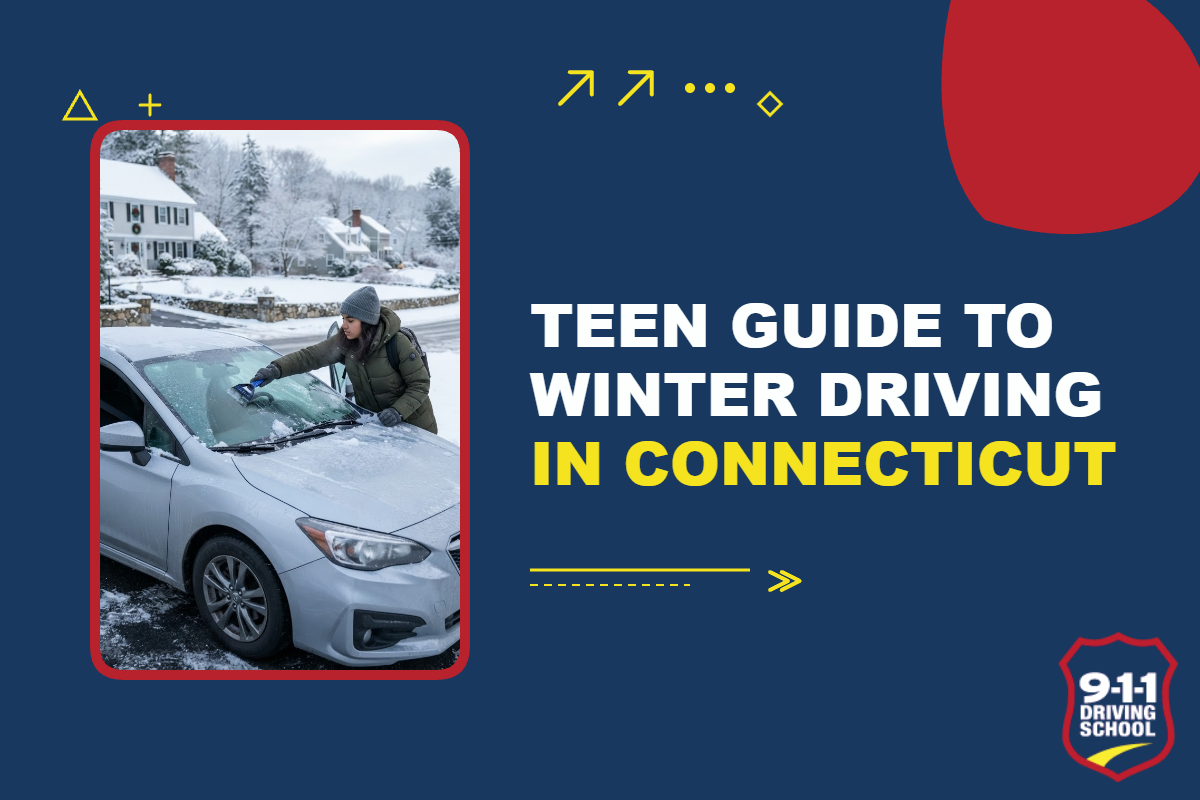
Teen guide to winter driving in Connecticut
Winter driving in Connecticut can feel completely different from the dry-road driving most teens practice during driver education. A morning route that felt easy in October can become harder in January when the road is wet, the shoulders are snow-covered, the windshield keeps fogging and drivers around you are reacting at different speeds.
For a new driver, the safest approach is to treat winter as a separate driving skill. Snow, freezing rain, slush, black ice and early darkness all reduce the time you have to see, decide and respond. That means teen drivers need more space, more patience and more planning before they drive in winter weather.
This guide explains how teen drivers can prepare for winter driving in Connecticut, what to practice with a parent or qualified trainer, how to handle snow and ice, and when it is better not to drive at all. It also includes official state resources such as the Connecticut driver’s manual, Connecticut DMV teen driver license requirements and CTDOT winter driving guidance so families can confirm the rules and safety recommendations directly from state sources.
Why winter driving is harder for teen drivers
Most winter crashes do not happen because a driver does not know what snow is. They happen because the driver keeps using dry-road habits after the conditions have changed. A teen may brake too late, follow too closely, turn too sharply, accelerate too quickly or assume that a road is clear because it looks only wet.
Connecticut adds a few challenges of its own. Coastal areas can move quickly from rain to slush. Inland towns can see more snow and colder pavement. Hills, curves, bridges, ramps and shaded side roads can stay slick after main roads look better. High-traffic roads such as I-84, I-91, I-95, Route 15 and local commuter routes can also become more stressful when visibility drops or traffic bunches up around plows and disabled vehicles.
The state driver manual reminds drivers that in heavy rain, snow or fog, visibility may be limited to only a short distance ahead. When visibility drops, a driver must slow enough to stop within the distance they can see. That one idea matters more than almost anything else in winter: if you cannot see far, you cannot safely drive fast.
Know the Connecticut teen driving rules before winter practice
Winter driving practice should still follow Connecticut teen driver rules. A learner’s permit holder must drive with a qualified trainer, and teen drivers should understand the state’s passenger, curfew, seat belt and mobile-device restrictions before they build winter driving experience.
According to the Connecticut DMV teen driver license requirements, 16- and 17-year-old applicants need required driver training and 40 hours of behind-the-wheel practice. The exact road-test eligibility timeline can depend on whether the teen completes commercial or secondary school training or home training.
The state also publishes Connecticut teen driving restrictions that explain passenger limits, the 11 p.m. to 5 a.m. curfew for licensed 16- and 17-year-old drivers, seat belt requirements and the prohibition on cell phone or mobile electronic device use while driving. Those rules still matter during winter. In fact, they matter more because snow, ice and darkness give a new driver less room for distraction or poor judgment.
Families doing home training should also review Connecticut’s required training for teen drivers, which notes that classroom training must cover the materials in the Connecticut driver’s manual. Winter practice should be treated as part of that larger training process, not as something a teen figures out alone after getting licensed.
Check road and weather conditions before leaving
Good winter driving starts before the car leaves the driveway. A teen should check the forecast, the route and the timing of the trip. If snow or freezing rain is expected during the drive, the safest decision may be to leave earlier, delay the trip or avoid driving until conditions improve.
CTDOT encourages drivers to stay informed and check weather forecasts and road conditions before driving in winter weather. Connecticut drivers can use the CTroads real-time traffic map to review traffic cameras, incidents, closures, delays, weather alerts and roadwork. The state also provides a Connecticut traffic information page that links drivers to current road and highway conditions.
Teens should not check these tools while driving. Look before leaving, or have a parent or passenger check conditions from a safe place. If conditions change while you are on the road, pull into a safe parking area before looking at a phone or traffic map.
- Check whether snow, sleet or freezing rain is expected during the trip.
- Look for crashes, closures, disabled vehicles and major delays along the route.
- Choose main roads when possible because they are more likely to be treated and cleared earlier than low-traffic shortcuts.
- Add extra time so you are not tempted to speed or make risky lane changes.
- Tell a parent or guardian where you are going and when you expect to arrive.
Clear all snow and ice from the vehicle
In Connecticut, clearing snow from a vehicle is not just a courtesy. Drivers must remove accumulated snow and ice from the vehicle, including the hood, trunk and roof, so it does not threaten people or property while the vehicle is moving. The official Connecticut snow and ice removal law addresses removal requirements and penalties.
For teen drivers, the simple rule is this: do not drive until you can see and until other drivers are protected from snow or ice flying off your vehicle. Clearing only a small patch of windshield is not enough. Snow left on the roof can slide forward when you brake. Ice left on the hood or trunk can break loose at speed. Snow covering lights or license plates can make it harder for other drivers to see what you are doing.
- Clear the windshield, side windows and rear window.
- Clear the roof, hood and trunk.
- Clear headlights, brake lights, turn signals and mirrors.
- Remove snow around the wiper area before turning on the wipers.
- Use the defroster long enough to prevent fogging before driving.
- Make sure you can see out of every window needed for safe driving.
Prepare the car before Connecticut winter weather arrives
Winter driving is much harder when the vehicle is not ready. A teen driver does not need to become a mechanic, but they should know what to check and when to ask an adult or technician for help.
The Connecticut Department of Public Health gives practical winter driving preparation guidance that includes making sure tires have adequate tread, keeping a windshield scraper and small broom in the vehicle, maintaining at least a half tank of gas during winter and planning long trips carefully.
Before the season begins, families should check:
- Tire tread and tire pressure
- Battery condition
- Brake performance
- Headlights and brake lights
- Turn signals and hazard lights
- Windshield wipers and washer fluid
- Heater and defroster
- Coolant and oil levels
- Ice scraper and snow brush
- Emergency supplies
Teens should also learn how the family vehicle behaves. A small front-wheel-drive car, an all-wheel-drive SUV and a pickup truck can feel very different in snow. All-wheel drive may help a vehicle start moving, but it does not make the vehicle stop faster on ice. Tires, speed and driver judgment matter more than confidence in the badge on the back of the vehicle.
Build a winter emergency kit
Every teen driver should have a basic emergency kit during the winter. This is especially important in Connecticut because a short drive can become a longer wait if traffic stops behind a crash, a plow route is delayed or a vehicle slides off the road.
CTDOT recommends carrying emergency supplies such as blankets, water, snacks, a flashlight and a first aid kit when driving in winter conditions. The state’s public health guidance also recommends food, water and warm clothing when travel is necessary during winter weather.
- Blanket or extra warm clothing
- Gloves and hat
- Water bottles
- High-energy snacks
- Flashlight and extra batteries
- Phone charger or power bank
- Small shovel
- Windshield scraper and snow brush
- First aid kit
- Jumper cables or a portable jump starter
- Reflective triangles or emergency flares where legal and safe
- A small bag of sand or traction material
The kit should be easy to reach. If the trunk is packed or frozen shut, the supplies will not help. Parents should show teens where the kit is stored and how to use the items safely.
Slow down before the road forces you to slow down
Speed is one of the biggest winter driving problems for new drivers. A teen may feel like they are driving slowly because they are below the speed limit, but the posted limit is for normal conditions. Snow, slush, fog, freezing rain and heavy traffic may require a much lower speed.
CTDOT tells drivers to reduce speed to match road conditions, allow for increased stopping distance and avoid sudden movements. That advice is especially important for teens. Winter driving should feel smooth and deliberate. Quick steering, sharp braking and fast acceleration all make traction problems more likely.
A good winter habit is to slow before trouble, not during it. Ease off the gas before curves. Brake earlier for intersections. Reduce speed before a downhill stretch. Give yourself time to react before a vehicle ahead stops suddenly.
Leave more following distance than you think you need
Following distance is the space cushion that gives a driver time to see a problem, decide what to do and stop safely. In winter, that cushion needs to be much larger because tires have less grip and stopping distances can increase quickly.
CTDOT winter guidance tells motorists to maintain a safe following distance and allow ample reaction time. For a teen, that means not copying the aggressive driver ahead. If another driver tailgates, cuts across lanes or rushes toward a traffic light, let them go. Your job is to leave enough space for your vehicle, your tires and your experience level.
- Increase space when roads are wet, snowy or icy.
- Increase space behind snowplows, buses, trucks and vehicles with snow still on them.
- Avoid following closely on ramps, hills, bridges and curves.
- Begin braking earlier than you would on a dry road.
- Watch two or three vehicles ahead so you can react before brake lights appear directly in front of you.
Use headlights, wipers and defrosters early
Visibility is one of the first things to disappear during a winter storm. Snow can cover lane markings. Slush can spray across the windshield. Fog can build inside the glass. Early darkness can make pedestrians and disabled vehicles harder to see.
The Connecticut driver’s manual explains that in very heavy rain, snow or fog, a driver may not be able to see far ahead and should pull off the road in a safe place when conditions become too poor to drive. Teens should treat this as permission to make a safe choice. If you cannot see, do not keep pushing forward just because traffic is moving.
Use low-beam headlights during snow, rain, fog and dim light. High beams can reflect off snow or fog and make visibility worse. Keep the windshield washer fluid full with winter-rated fluid, and replace worn wiper blades before they start streaking.
- Turn headlights on before visibility gets bad.
- Use the defroster to keep interior glass clear.
- Keep a safe place to pull over in mind if visibility drops suddenly.
- Do not drive with a fogged windshield while trying to wipe it with your hand.
- Keep sunglasses in the vehicle for bright glare off snow during daytime driving.
Practice smooth braking and steering
A common winter mistake is treating the pedals and steering wheel like on-off switches. New drivers may press the brake too hard, yank the wheel when the car drifts or accelerate too quickly after a stop. On snow or ice, those habits can break traction.
Winter driving works better when everything is smooth: look far ahead, ease off the gas early, brake gradually, steer gently and accelerate lightly. The goal is to avoid asking the tires to do too much at once.
When safe and legal, parents can help teens practice in an empty lot after a light snowfall. The purpose is not to slide around. It is to feel how much longer the vehicle takes to stop, how easily the tires lose grip and how gentle steering corrections help the vehicle stay pointed where it should go.
Understand skids before one happens
A skid can surprise a new driver because the vehicle may not respond the way it normally does. The Connecticut driver manual explains that skids happen when tires can no longer grip the road and that traveling too fast for conditions is a common cause.
The same manual advises drivers to stay off the brake during a skid until the vehicle slows, steer in the direction they want the vehicle to go and continue correcting until the vehicle is under control again. Teens should learn this before winter, not during the first slide on a public road.
If the vehicle has antilock brakes, press firmly and keep pressure on the brake during an emergency stop. The pedal may pulse when ABS is working. Do not pump the brakes on an ABS-equipped vehicle. If the vehicle does not have ABS, the driver may need to brake differently to avoid locking the wheels. Families should review the vehicle owner’s manual together.
- Do not panic and jerk the wheel.
- Look where you want the vehicle to go.
- Ease off the accelerator.
- Avoid slamming the brake during a skid.
- Steer smoothly and correct gradually.
- After recovering, slow down and increase space.
Be extra careful on bridges, ramps, hills and shaded roads
Some places become slippery before the rest of the road. Bridges and overpasses can freeze sooner because cold air reaches the pavement from above and below. Exit ramps and entrance ramps can be slick from packed snow and hard braking. Hills and curves reduce your margin for error because the vehicle may need to turn, climb, descend and slow at the same time.
Teens should approach these areas with less speed and more space. Do not brake hard in the middle of a curve if you can slow before entering it. Do not accelerate sharply up a hill. Do not assume a bridge is safe because the road before it looked wet.
A parent or qualified trainer can turn this into a practice topic. Drive the same safe route in dry weather first. Identify the bridge decks, shaded corners, steep grades and ramp curves. Then talk through how the teen would adjust speed and following distance during a winter storm.
Give snowplows plenty of room
Snowplows are part of winter driving in Connecticut. They move slowly because they are clearing and treating the road. A teen driver may feel tempted to pass one, especially if they are late. That is usually a bad decision.
CTDOT’s snow and ice operations information explains that there is no state law that flatly prohibits passing a snowplow, but it also says passing can be extremely dangerous. The road ahead of the plow may be less clear, visibility can be reduced by snow clouds, and the plow may be spreading material or moving snow to the side.
CTDOT also advises drivers to stay clear of snowplows, avoid blind spots and allow operators enough space to do their work. For teens, the safest rule is simple: stay well back, be patient and do not crowd or pass a working plow unless a police officer or clear traffic control makes it safe and necessary.
- Do not tailgate a plow.
- Avoid the rear corners and side blind spots.
- Expect snow, salt or slush to come from the plow area.
- Remember that the road in front of the plow may be worse than the road behind it.
- Let the plow driver work instead of trying to beat the storm.
Know when not to drive
One of the most mature winter driving decisions is choosing not to drive. Teens often think safe driving means handling every condition. In reality, safe driving includes knowing when the conditions are beyond your skill level.
CTDOT encourages drivers to postpone travel if conditions are severe. The state public health winter driving guidance also advises careful trip planning and recommends using public transportation if you must go out during a winter storm. A new driver should not feel pressured to drive through heavy snow, ice or very poor visibility just because they have a license.
A teen should talk with parents before winter about what conditions mean no driving. This removes pressure in the moment. For example, the family might decide that the teen will not drive during active freezing rain, heavy snow, high winds, unplowed roads, school closures due to weather or late-night winter storms.
Winter night driving for Connecticut teens
Winter brings earlier sunsets, which means many normal teen activities happen after dark. A drive home from practice, work or a school event may include low visibility, glare from headlights, wet pavement and refreezing roads.
Licensed Connecticut drivers who are 16 or 17 must follow the state curfew from 11 p.m. to 5 a.m. unless an exception applies, such as employment, school, religious activities or medical necessity. The details are listed in the Connecticut teen driving restrictions. Teens should not assume every late-night activity automatically qualifies, and passenger restrictions still apply.
Even when a trip is allowed, night winter driving should be limited until the teen has enough supervised experience. Parents can help by planning practice drives at dusk before allowing independent nighttime winter trips.
- Clean headlights and taillights before leaving.
- Reduce speed so you can stop within the area illuminated by your headlights.
- Use low beams in snow or fog.
- Watch for pedestrians wearing dark clothing.
- Be alert for icy patches after the temperature drops below freezing.
- Avoid unnecessary passengers and distractions.
How parents can structure winter driving practice
Teen winter driving should be introduced gradually. A good practice plan gives the teen experience without putting them in conditions they are not ready to manage.
Step 1: Review the rules and vehicle controls
Before winter practice begins, review the driver manual, teen restrictions and vehicle controls. The teen should know how to use the headlights, hazard lights, wipers, washer fluid, defroster, heat, mirrors and parking brake without searching.
Step 2: Practice in calm conditions
Start with dry or lightly wet roads. Work on smooth braking, gentle turns, early signals, mirror checks, lane position and steady following distance. These habits need to be solid before adding snow or ice.
Step 3: Add light winter conditions
When it is safe and legal, practice during light snow or after roads have been treated. Choose low-speed streets and parking lots first. Let the teen feel reduced traction in a controlled setting.
Step 4: Practice route planning
Ask the teen to plan a winter route using traffic and weather information. Have them choose main roads, identify risky sections and explain where they would pull over if visibility became unsafe.
Step 5: Discuss no-drive situations
Agree on conditions that are off-limits for independent teen driving. This can include heavy snowfall, freezing rain, unplowed roads, poor visibility, late-night storms or any situation where the teen feels uncertain.
Common winter driving mistakes teens should avoid
Driving too fast for conditions
A teen can be under the posted speed limit and still be driving too fast. If the road is slick, visibility is low or traffic is stopping suddenly, slow down.
Following too closely
Tailgating removes the space needed to stop. In winter, leave enough distance to brake gradually instead of reacting at the last second.
Braking hard on ice
Hard braking can start or worsen a skid. Brake earlier and more smoothly. Know how the vehicle’s ABS works before you need it.
Overcorrecting during a skid
Jerking the wheel can make the vehicle swing in the opposite direction. Look where you want to go and steer smoothly.
Leaving snow on the roof
Snow or ice can slide onto your windshield or fly into another vehicle. Clear the entire vehicle before driving.
Using high beams in snow or fog
High beams can reflect light back at you and reduce visibility. Low beams are usually the better choice in snow, rain or fog.
Assuming all-wheel drive solves everything
All-wheel drive may help you move, but it does not cancel physics. You still need room to stop, gentle steering and appropriate tires.
Checking the phone for road conditions while driving
Plan before leaving or pull over safely. Connecticut teen drivers are not allowed to use mobile electronic devices while driving, and winter roads make distraction even more dangerous.
What to do if visibility becomes unsafe
Snow squalls, fog, freezing rain and spray from other vehicles can make it hard to see. If visibility becomes unsafe, do not simply keep driving and hope it improves.
- Slow down gradually.
- Increase following distance.
- Turn on low-beam headlights if they are not already on.
- Use wipers, washer fluid and defrosters as needed.
- Avoid sudden lane changes.
- Look for a safe place to pull off the road if you cannot see far enough to continue.
- If you stop because of a vehicle problem, turn on hazard lights and stay out of traffic lanes.
The Connecticut driver manual advises drivers with vehicle trouble to get off the road and away from traffic if possible, use emergency flashers and never stand in the roadway. Those instructions are especially important when other drivers may have limited visibility and less ability to stop.
What to do if you get stuck or stranded
Getting stuck can happen even to experienced drivers. A teen should know the family plan before winter. The first step is to stay calm and focus on staying safe, warm and visible.
- Call a parent, guardian or roadside assistance.
- Call 911 if there is an immediate danger, injury or unsafe location.
- Turn on hazard lights if the vehicle is near traffic.
- Stay with the vehicle unless it is unsafe to do so.
- Do not stand in the roadway.
- Use emergency supplies while waiting.
- Keep the exhaust area clear if the engine is running for heat.
- Run the engine only as needed if fuel is limited.
Teens should not try to push a vehicle out of snow near moving traffic. They should also avoid spinning the tires aggressively, which can dig the vehicle deeper and damage components.
A simple Connecticut winter driving checklist for teens
Before leaving in winter weather, ask these questions:
- Is this trip necessary right now?
- Have I checked the forecast and road conditions?
- Is the route mostly on main roads that are likely to be treated?
- Does a parent or guardian know where I am going?
- Is the vehicle completely cleared of snow and ice?
- Are the headlights, taillights and signals clear?
- Do I have enough washer fluid and fuel?
- Are my phone and charger available for emergencies, but put away while driving?
- Do I have an emergency kit?
- Am I calm enough to drive slowly and patiently?
If the answer to any of these questions is no, fix the problem before driving or delay the trip.
Frequently asked questions about teen winter driving in Connecticut
Should a new teen driver drive during a snowstorm?
Usually, no. A teen driver should avoid active snowstorms, freezing rain and poor visibility whenever possible. Connecticut state guidance encourages drivers to postpone travel when conditions are severe. Winter driving experience should begin in controlled, lower-risk situations with supervision.
Can a Connecticut teen with a learner’s permit practice in snow?
A teen with a learner’s permit must follow Connecticut permit rules and drive with a qualified trainer. Light winter practice may be helpful when conditions are safe, but it should be supervised and limited to low-risk areas until the teen has more experience.
Do Connecticut teens need to clear snow from the whole vehicle?
Yes. Connecticut law requires drivers to remove accumulated snow and ice from the vehicle, including the hood, trunk and roof, so it does not pose a threat while the vehicle is being operated. It is also a basic visibility and safety step.
Should teens use all-wheel drive differently in snow?
Teens should not treat all-wheel drive as a substitute for safe winter habits. All-wheel drive may help with traction when accelerating, but the vehicle still needs more distance to stop and can still skid on ice.
How much following distance should a teen leave in winter?
More than they would on a dry road. There is no single number that fits every storm, but snow, slush and ice require a much larger space cushion. If the road is slick, the teen should slow down and leave enough room to brake gradually.
What is the best way to practice winter driving?
Start with a parent or qualified trainer in calm conditions, then add light winter conditions only when it is safe. Practice smooth braking, steering, following distance, visibility checks and route planning before attempting busier roads.
Winter driving in Connecticut is not about being fearless. It is about being prepared, patient and honest about road conditions. New drivers should slow down, leave more space, clear the vehicle completely, check conditions before leaving and avoid driving when the weather is beyond their skill level.
For parents, the goal is to give teens structured practice before they face winter roads alone. Review the rules, use official state resources, ride along in different conditions and talk through decisions before mistakes happen.
For teens, the safest winter driving habit is simple: make every move earlier and smoother than you would on a dry road. Look earlier, brake earlier, signal earlier, slow earlier and decide earlier. That extra time is what keeps winter driving manageable.