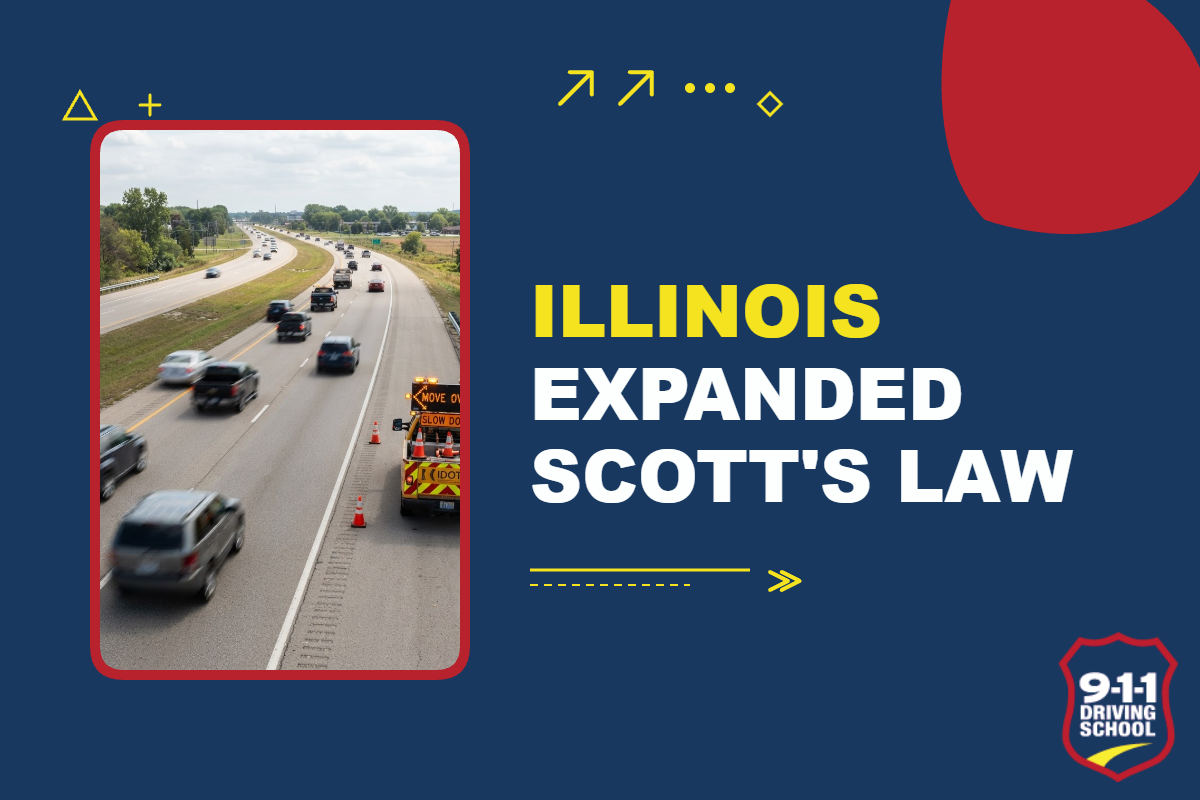
Illinois expands Scott’s Law for emergency scenes
Illinois has expanded Scott’s Law to give emergency workers, first responders and people involved in roadside emergencies more protection from passing traffic. For new drivers, this is not just another rule to memorize for a permit test. It is one of the most important real-world safety laws to understand before driving on Illinois roads.
Scott’s Law is Illinois’ move over law. The basic idea is simple: when you approach flashing lights, emergency activity or a vehicle stopped on the roadside, you slow down, move over when it is safe and leave extra space. The recent expansion makes that duty clearer for emergency scenes, including situations where workers or pedestrians are on or near the roadway.
The Illinois State Police Move Over Law page summarizes the current rule for drivers, and the Illinois Vehicle Code Section 11-907 contains the law’s detailed statutory language. This guide explains what changed, what new drivers should do, and how to make Scott’s Law part of everyday safe driving.
Note: This article is for driver education and general safety information. It is not legal advice. For a ticket, crash, license suspension or court matter, review the law directly and speak with a qualified professional.
What is Scott’s Law in Illinois?
Scott’s Law is the Illinois law that requires drivers to slow down and move over when approaching certain vehicles, emergency scenes and roadside situations involving flashing lights. It is also commonly called the Move Over Law.
The law is named in memory of Chicago Fire Department Lieutenant Scott Gillen, who was killed in 2000 while responding to a crash. The purpose of the law is to protect people who may be standing, working, directing traffic or assisting others just feet away from moving vehicles.
For new drivers, the most important concept is distance. When you see emergency lights, hazard lights, tow activity, road maintenance activity or a crash scene, your job is to create more room and reduce speed before you pass.
The Illinois Secretary of State also publishes a driver-facing Scott’s Law – Move Over It’s the Law brochure that explains the core message in simple terms: slow down, drive with caution and move over to another lane when it is safe to do so.
What changed with the Scott’s Law expansion?
The recent expansion is important because it clarifies that drivers may have to yield in more emergency-scene situations than a new driver might expect. The older understanding of Scott’s Law often focused on a stationary emergency vehicle stopped on the shoulder. That rule still matters, but the expanded language goes further.
The Illinois General Assembly’s Public Act 104-0400 amends Section 11-907 of the Illinois Vehicle Code and adds language requiring drivers to yield to an authorized emergency vehicle that is obviously and actually engaged in work on a highway, whether the vehicle is stationary or not, when it is displaying flashing lights.
The same update also adds language requiring drivers to yield the right-of-way to an emergency worker who is obviously and actually working on a highway at an emergency scene. It also requires drivers to yield to a pedestrian on the highway who is directly involved in the emergency scene.
In plain language, new drivers should not think of Scott’s Law as applying only to a police car parked on the shoulder. It can also apply when emergency activity is active, workers are exposed and pedestrians connected to the emergency scene are in a vulnerable position.
Quick summary for new drivers
When you approach an emergency scene in Illinois, remember these basics:
- Slow down before you reach the scene.
- Check mirrors and surrounding traffic early.
- Move over into a non-adjacent lane when it is legal and safe.
- If you cannot move over safely, reduce speed and leave as much space as possible.
- Be prepared to stop if people, vehicles or equipment are near the roadway.
- Yield to emergency vehicles displaying flashing lights, whether stationary or not, when they are engaged in work on the highway.
- Yield to emergency workers and pedestrians directly involved in an emergency scene.
- Do not use the scene as a distraction. Keep your eyes moving and your phone away.
- Continue driving carefully until you are fully past the scene.
What counts as an emergency scene?
Under the statutory language, an emergency scene generally involves a location where a stationary authorized emergency vehicle is present and has activated oscillating, rotating or flashing lights. For a new driver, the safest practical approach is to treat flashing lights and roadside emergency activity as a signal to slow down, create space and prepare for unpredictable movement.
An emergency scene could include a crash response, a vehicle fire, a medical response, a traffic stop, a disabled vehicle being assisted by a tow operator, a road hazard response or a situation where emergency personnel are directing drivers around a problem.
The Illinois Tollway Give Them Distance campaign explains the safety idea behind the law: drivers should give extra room to people working or stopped near moving traffic. That message is especially useful for teens and new drivers because emergency scenes can change quickly.
Which vehicles are covered by Scott’s Law?
Many new drivers hear ’emergency vehicle’ and think only of police cars, ambulances and fire trucks. Those vehicles are covered, but Scott’s Law can apply more broadly.
The Illinois State Police explains that vehicles legally displaying these kinds of warning lights can include police, fire, construction, highway maintenance, tow and ambulance vehicles. The exact legal definition depends on whether the vehicle is authorized by law to use oscillating, rotating or flashing lights and whether the operator is engaged in official duties.
Common examples include:
- Police vehicles
- Fire department vehicles
- Ambulances and emergency medical vehicles
- Tow trucks assisting a driver
- Highway maintenance vehicles
- Construction or work-zone vehicles with authorized warning lights
- Other authorized vehicles displaying qualifying flashing, rotating or oscillating lights
The better habit is not to ask, ‘Does this exact vehicle count?’ while you are already close to the scene. When you see flashing lights and roadside activity, begin slowing down, check for a safe lane change and create space.
How to slow down and move over safely
The law does not tell drivers to swerve or make an unsafe lane change. Moving over is required when it can be done safely with due regard for traffic and road conditions. New drivers should learn the sequence before they need it.
- Look far ahead for flashing lights, hazard lights, stopped traffic or people near the roadway.
- Ease off the accelerator instead of waiting until the last second to brake.
- Check your rearview mirror to understand what traffic behind you is doing.
- Check the side mirror and blind spot for the lane you want to enter.
- Signal early if a lane change is safe and legal.
- Move over smoothly into a lane that is not next to the emergency vehicle or emergency scene.
- Keep reducing speed as needed and leave extra space until you are fully past the scene.
- Return to your lane only when it is safe and you are clear of the activity.
If another vehicle is beside you, if traffic is too heavy or if road conditions make a lane change unsafe, do not force your way over. Slow down, maintain control and give the emergency scene as much distance as the road allows.
What to do on multi-lane roads
On a highway with at least four lanes and at least two lanes moving in your direction, the expected response is to change lanes away from the emergency vehicle or emergency scene when it is safe to do so. This is the classic move-over situation.
For example, if an ambulance is stopped on the right shoulder of a four-lane roadway, a driver in the right lane should check traffic and move into the left lane when possible. If the driver is already in a non-adjacent lane, they should still slow down and pass carefully.
New drivers should practice scanning far enough ahead to see these situations early. If you notice flashing lights only when you are almost beside them, you have waited too long. Early recognition gives you time to check mirrors, signal and make a safe decision.
What to do on two-lane roads
On two-lane roads, moving over into another same-direction lane may not be possible. That does not mean you can pass at normal speed. You still need to slow down, proceed with caution and leave as much safe distance as possible.
If the emergency scene is on the shoulder, move within your lane when it is safe and legal, but do not cross into oncoming traffic unless the road, markings, visibility and conditions clearly allow it. The safer response is usually to reduce speed early, keep both hands on the wheel and be ready for a worker, responder or pedestrian to step into view.
At night, in rain, in snow or near curves, slow down even more. Roadside workers may be harder to see, and the flashing lights themselves can make it more difficult for a new driver to judge distance and lane position.
What to do when traffic is heavy
Heavy traffic makes Scott’s Law situations more difficult because every driver is trying to react at the same time. New drivers should avoid sudden movements and focus on communicating clearly.
In heavy traffic:
- Begin slowing down as soon as you identify flashing lights.
- Use your turn signal before trying to move over.
- Do not cut off another driver to create space.
- Avoid hard braking unless it is necessary to prevent a crash.
- Let faster or aggressive drivers pass instead of competing for space.
- Keep a safe following distance because other drivers may brake suddenly.
A new driver may feel pressure when traffic behind them is moving quickly. Scott’s Law is a reminder that the people outside their vehicles are more vulnerable than the drivers inside traffic. Reduce speed in a controlled way and make the safest available choice.
What to do if you are the driver stopped on the shoulder
Scott’s Law also matters when you are the person with a flat tire, mechanical problem or emergency on the shoulder. The goal is to make your vehicle visible and keep yourself protected from traffic.
The Give Them Distance roadside safety guidance advises motorists who are stopped on the shoulder because of an emergency or vehicle problem to activate hazard lights, call for help when appropriate, stay in the vehicle with seat belts on and wait for an emergency vehicle to arrive.
If you are stranded:
- Turn on your hazard lights immediately.
- Pull as far away from traffic as you safely can.
- Stay in the vehicle with your seat belt fastened if it is safe to do so.
- Call for roadside assistance or emergency help if needed.
- Do not stand between vehicles or walk along the traffic side of the car.
- Wait for trained help before trying to handle a dangerous roadside situation.
A new driver may be tempted to get out and inspect the problem right away. On a busy roadway, that can be extremely dangerous. Visibility, traffic speed and shoulder width all matter.
How the expansion affects pedestrians at emergency scenes
One of the most important parts of the expansion is the requirement to yield to a pedestrian on the highway who is directly involved in an emergency scene. This matters because not every person at a roadside emergency will be in uniform.
A person involved in an emergency scene could be a driver from a crash, a passenger from a disabled vehicle, someone helping direct people away from danger or a person moving around because of the emergency. The exact facts of a situation matter, but a new driver should not wait to decide whether a person ‘counts’ under the law.
When people are near the roadway, slow down, increase your following distance, avoid distractions and prepare to stop. The safest decision is usually to assume that a person near an emergency scene may move unexpectedly.
Penalties for violating Scott’s Law
Illinois treats Scott’s Law violations seriously because the consequences of failing to slow down or move over can be severe. A violation can lead to major fines, possible court consequences and license-related penalties when a crash causes damage, injury or death.
The Illinois State Police Scott’s Law penalty summary lists fines of $250 to $10,000 for a first violation and $750 to $10,000 for a second or subsequent violation. It also explains that more serious consequences may apply if a violation results in property damage, injury or death.
The statutory penalty language in Illinois Vehicle Code Section 11-907 also includes potential suspension periods when certain violations result in damage, injury or death. For a new driver, even one serious traffic case can affect licensing, insurance and future driving privileges.
A new driver should understand these practical consequences:
- A ticket can be expensive even before court costs or other fees are considered.
- A moving violation can affect a young driver’s record.
- A violation connected to a crash can become much more serious.
- A license suspension can disrupt school, work and family transportation.
- Insurance costs may increase after traffic violations or crashes.
The easiest way to avoid those consequences is to build the habit early: flashing lights mean slow down, move over when safe and stay alert until the scene is fully behind you.
How Scott’s Law connects to disabled vehicles
Illinois also has a related rule for approaching disabled vehicles with hazard lights on certain highways. The Illinois Vehicle Code Section 11-907.5 on approaching disabled vehicles requires drivers on qualifying multi-lane highways to move over when safe or reduce speed and leave safe distance when moving over would be impossible or unsafe.
This matters because new drivers may focus only on police, fire or ambulance lights and overlook a disabled vehicle with hazards flashing. A stranded driver standing beside a car is also vulnerable. Treat hazard lights as an early warning to slow down and give space.
The practical habit is the same: recognize the hazard early, check traffic, signal if you can move over, reduce speed and keep extra space until you are safely past.
Why this rule is especially important for teen drivers
Teen and first-time drivers are still developing speed judgment, mirror habits, lane-change timing and decision-making under pressure. Emergency scenes combine all of those skills at once.
A new driver approaching flashing lights may have to answer several questions quickly: Is traffic slowing? Can I change lanes safely? Is someone standing on the shoulder? Is another vehicle braking ahead of me? Is the road wet? Is there room to move over?
Illinois’ graduated driver licensing program is built around the idea that new drivers need supervised practice and gradual exposure before handling every situation independently. Scott’s Law situations should be part of that practice.
Parents and instructors can help by talking through real examples from the passenger seat. When the teen sees emergency lights ahead, ask what they should do before reaching the scene. The goal is not to quiz them after the moment has passed. The goal is to teach early recognition.
How to practice Scott’s Law with a teen driver
A parent, guardian or instructor can build this skill into normal practice drives. Use calm, specific coaching instead of waiting until the teen is already close to the emergency scene.
Practice these habits:
- Ask the teen to identify flashing lights as soon as they see them.
- Have the teen check the rearview mirror before slowing.
- Talk through whether a lane change is safe.
- Practice using the signal before moving over.
- Practice slowing smoothly when a lane change is not safe.
- Point out pedestrians, tow operators, road workers and emergency responders near the road.
- Discuss how rain, darkness, construction or curves change the driver’s response.
The official Illinois Rules of the Road and traffic safety publications are also useful resources for reviewing the larger set of Illinois driving rules that new drivers need to know.
Common mistakes new drivers make near emergency scenes
Waiting too long to react
The biggest mistake is noticing the emergency scene too late. New drivers sometimes stare at the vehicle in front of them instead of scanning farther down the road. Look ahead so you can respond gradually.
Moving over without checking the blind spot
The move-over rule does not override safe lane-change habits. Check mirrors, signal and check the blind spot before moving. A sudden lane change can cause another crash.
Slowing down only a little
Passing close to an emergency scene at normal speed is dangerous, even if you cannot move over. Slow enough to account for traffic, visibility, road conditions and people near the roadway.
Staring at the crash or emergency activity
Drivers sometimes look at the emergency scene instead of the path ahead. This can lead to drifting, rear-end crashes or missing a person stepping into view. Glance, understand the hazard and keep driving under control.
Following another vehicle too closely
Emergency scenes often cause sudden braking. Increase following distance before reaching the area so you have room to react.
Using a phone near the scene
Do not text, record, take pictures or search for directions while passing an emergency scene. New drivers already need all of their attention for speed control, lane position and hazard recognition. Illinois also prohibits texting while driving, and drivers under age 19 have additional cellphone restrictions under the teen driving rules.
What emergency vehicles with lights and sirens require
Scott’s Law often deals with stopped or active emergency scenes, but new drivers also need to understand what to do when an emergency vehicle is approaching with lights and sirens. Section 11-907 includes rules requiring drivers to yield the right-of-way and move as close as possible to the right-hand edge or curb, clear of intersections, when an authorized emergency vehicle is approaching with required signals.
In everyday terms, when you hear sirens or see an emergency vehicle coming from behind or ahead, do not panic. Check mirrors, signal if needed, move right when safe and stop if necessary so the emergency vehicle can pass. Do not stop in the middle of an intersection.
This is different from passing a stationary scene, but the safety goal is the same: give emergency responders the space they need to do their job.
How weather and visibility change your response
Rain, snow, fog, glare and darkness make emergency scenes more hazardous. Flashing lights can reflect off wet pavement or windshields, and workers may be harder to see until you are close.
In poor visibility:
- Reduce speed sooner.
- Increase following distance.
- Avoid sudden lane changes.
- Use low beams when appropriate in rain, fog or snow.
- Watch for cones, flares, reflective vests and traffic-control directions.
- Expect other drivers to react unpredictably.
The safest new drivers are not the ones who know the rule only in perfect conditions. They are the ones who adjust their response when the road changes.
What to remember for the permit test and road test
A new Illinois driver should understand Scott’s Law both as a written-test concept and as a real driving habit. On a knowledge test, the answer usually comes down to slowing down, moving over when safe and yielding appropriately to emergency vehicles, workers or people involved in a roadside emergency.
During actual driving, the examiner or instructor is looking for safe judgment. That includes noticing hazards early, checking mirrors before changing speed, signaling properly, making safe lane changes and maintaining control of the vehicle.
The rule is not just about avoiding a ticket. It is about protecting people who may have nowhere to go if a driver passes too fast or too close.
A simple phrase new drivers can remember
When you see flashing lights or roadside emergency activity, remember this phrase: slow, check, move, protect.
- Slow: Reduce speed before you reach the scene.
- Check: Check mirrors, traffic, lane markings and blind spots.
- Move: Move over when it is safe and legal.
- Protect: Leave space for emergency workers, pedestrians and stranded drivers.
That simple sequence helps a new driver avoid the two most common errors: reacting too late and moving too suddenly.
Frequently asked questions about Illinois Scott’s Law
Does Scott’s Law apply only to police cars?
No. Scott’s Law can apply to multiple types of authorized vehicles displaying qualifying lights, including police, fire, ambulance, tow, construction and highway maintenance vehicles. The Illinois State Police page gives several examples of covered vehicle types.
Do I always have to change lanes?
You must change lanes away from the emergency vehicle or scene when it is possible and safe under the road and traffic conditions. If changing lanes would be unsafe or impossible, slow down, proceed with due caution and leave safe distance until you are past the scene.
What if traffic will not let me move over?
Do not force a lane change. Reduce speed, maintain control, leave as much space as possible and continue past the scene carefully. A safe response is better than a sudden or aggressive lane change.
Does the expansion cover emergency workers on foot?
Yes. The expanded language requires drivers to yield to emergency workers who are obviously and actually working on a highway at an emergency scene. It also includes pedestrians on the highway who are directly involved in the emergency scene.
Does Scott’s Law apply if the emergency vehicle is moving?
The expanded language adds a duty to yield to an authorized emergency vehicle that is obviously and actually engaged in work on the highway, whether stationary or not, when displaying flashing lights. Drivers should treat active emergency activity with caution even when the vehicle is not parked on the shoulder.
What are the fines for violating Scott’s Law?
According to Illinois State Police, a first violation can carry a fine from $250 to $10,000, and a second or subsequent violation can carry a fine from $750 to $10,000. More serious consequences may apply when a violation causes damage, injury or death.
Does Illinois have a related rule for disabled vehicles?
Yes. Illinois has a separate rule for approaching disabled vehicles with lighted hazard lights on certain multi-lane highways. The safe habit is similar: move over when safe, or slow down and leave safe distance if moving over is not possible.
Should a teen driver practice this before driving alone?
Yes. Scott’s Law situations require speed control, hazard recognition, lane-change judgment and calm decision-making. Parents and instructors should discuss these situations during supervised practice drives.
Final checklist for new drivers
Before driving independently in Illinois, a new driver should be able to answer yes to each of these:
- I know that Scott’s Law means slow down and move over when safe.
- I know that the law can apply to more than police cars.
- I know how to pass a stopped emergency vehicle on a multi-lane road.
- I know what to do when I cannot safely change lanes.
- I know that emergency workers and pedestrians at emergency scenes need extra protection.
- I know that flashing lights and hazard lights mean I should pay attention early.
- I know not to stare, film or text near an emergency scene.
- I know that violations can lead to major fines and license consequences.
- I have practiced slowing, checking, signaling and moving over safely with a supervising driver.
Illinois expanded Scott’s Law because emergency scenes are dangerous for everyone involved. First responders, tow operators, road workers, stranded drivers and pedestrians may have only a narrow shoulder separating them from fast-moving traffic.
For new drivers, the rule should become automatic: when you see flashing lights or roadside emergency activity, slow down, check your surroundings, move over when safe and leave extra distance until you are fully past the scene.
The safest drivers do not wait until the last second. They scan ahead, make calm decisions and give emergency scenes the room they deserve.