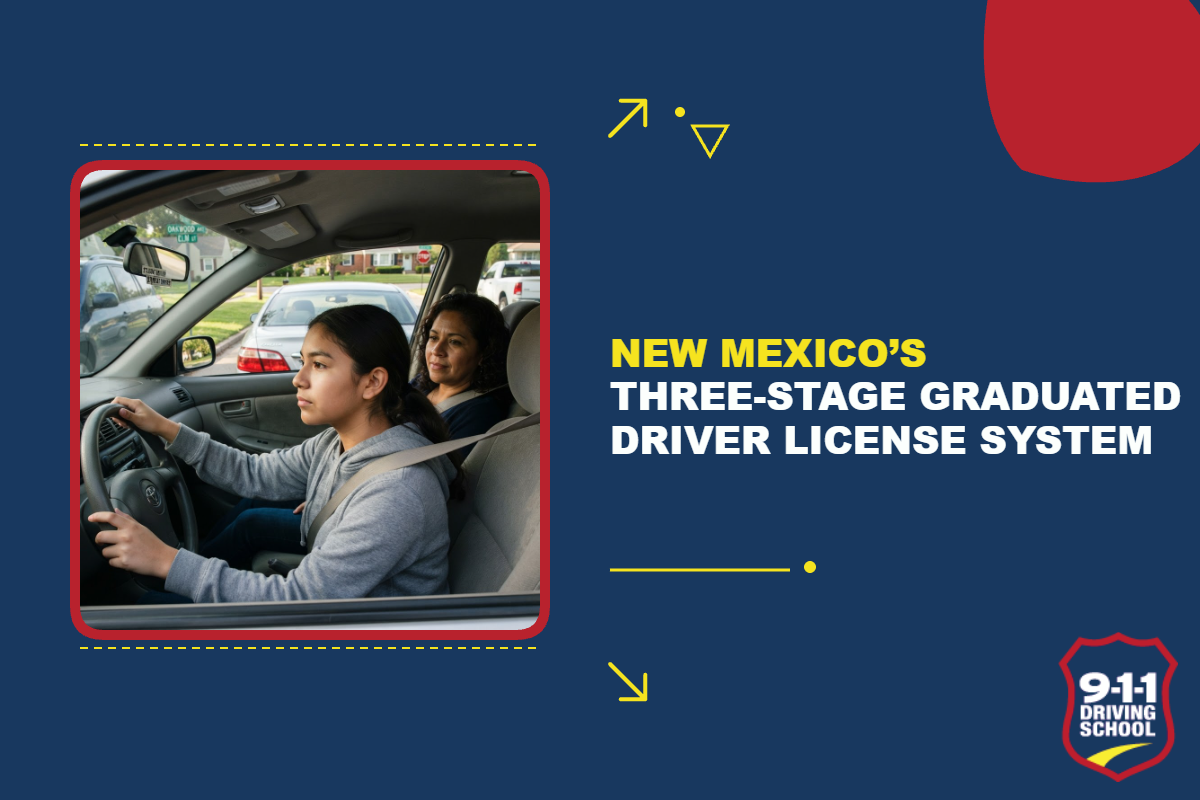
New Mexico’s three-stage graduated driver license system
Getting a driver’s license is a major milestone for a teen, but in New Mexico it is not meant to happen all at once. The state uses a graduated driver license system, often called GDL, to help new drivers build experience before they receive full driving privileges.
According to the New Mexico Motor Vehicle Division’s graduated licensing guidance, drivers under age 18 must move through three stages before receiving a full, unrestricted license: an instructional permit, a provisional license and then a full license.
For families, the process is easier when everyone understands what each stage allows, what each stage requires and what can delay a teen from moving forward. This guide walks through the three stages in plain language so parents and teen drivers know what to expect.
Why New Mexico uses graduated driver licensing
New drivers need time to learn how traffic really works. A permit test proves that a teen understands basic rules, but it does not prove that the teen is ready for independent driving in every situation. Weather, nighttime visibility, high-speed roads, passengers, intersections and distractions all add pressure that new drivers must learn to manage.
The New Mexico Department of Transportation driver education and safety program explains that state-approved driver education starts the three-stage GDL process and is designed to build safe driving skills, attitudes and behaviors.
The purpose of GDL is not to make licensing more confusing. It is to reduce risk by slowly adding responsibility. A teen begins with supervised driving, moves to limited independent driving and then earns full privileges after completing the required practice, keeping a clean record and following the provisional license restrictions.
The three stages at a glance
New Mexico’s teen licensing system includes these three stages:
- Stage 1: instructional permit. The teen drives only with a qualified supervising adult while completing driver education and supervised practice hours.
- Stage 2: provisional license. The teen may drive without a supervising adult in many situations, but must follow passenger and nighttime driving restrictions.
- Stage 3: full license. The teen receives full, unrestricted driving privileges after completing the provisional period and meeting the final record requirements.
The earliest timeline only works when a teen completes every requirement on schedule. Traffic violations, pending citations, incomplete practice hours or missing documents can delay the process.
Stage 1: instructional permit
The instructional permit is the first formal step in New Mexico’s GDL system. It gives a teen permission to practice on public roads, but only under supervision.
A teen must be at least 15 years old to apply for an instructional permit. The MVD’s instructional permit requirements also state that the applicant must provide proof of completing or being enrolled in a state-approved driver education program.
What a teen needs to apply for an instructional permit
At the MVD field office, the teen and parent or guardian should be ready for the application process. Requirements can vary depending on whether the family is applying for a REAL ID credential or a standard license, but the application generally involves identity, age and residency documentation.
Families should review the MVD’s page on what to bring for a first New Mexico driver license before visiting an office, because all required documents should be collected ahead of time.
A teen applicant should generally be prepared to:
- Bring a parent or legal guardian to the MVD field office.
- Show proof of enrollment in or completion of an approved driver education program.
- Provide required proof of identity, age and New Mexico residency.
- Complete and sign the instructional permit application with a parent or guardian.
- Pass the vision test.
- Pass the MVD knowledge exam, unless the exam is handled through an approved driver education provider.
- Provide the driver education referral card when required.
- Pay the instructional permit fee.
The New Mexico driver’s license manuals page is the best place to find official study materials for the knowledge test, including the state driver’s manual.
What the instructional permit allows
The MVD’s Chapter 3 instructional permit guidance says the teen must drive with an adult who is at least 21 years old and has been licensed for at least three years.
This supervising adult should sit beside the teen and actively coach the drive. The permit stage is not the time for a parent to simply ride along silently while the teen repeats the same route. Good supervised practice should expose the teen to a variety of roads, intersections, traffic levels and weather conditions.
What must be completed during the permit stage
Before moving to the provisional license, a teen must complete the permit-stage requirements. Those include:
- Holding the instructional permit for at least six months.
- Completing and passing a state-approved driver education program.
- Completing the required DWI prevention and education component.
- Driving only with a qualified adult supervisor.
- Completing at least 50 hours of supervised driving practice.
- Completing at least 10 of those supervised hours at night.
- Keeping a driving log that can be signed by a parent or guardian.
- Maintaining a clean driving record for the required period before applying for the provisional license.
The driving log matters. Parents should not wait until the week before the road test to reconstruct months of practice from memory. Record dates, times, road types, weather conditions and night hours as the practice happens.
How parents should structure permit-stage practice
The 50-hour requirement is a minimum, not a guarantee of readiness. A teen who has completed 50 easy hours in quiet neighborhoods may still be unprepared for heavy traffic, higher speeds or complicated intersections.
A better approach is to build the practice gradually:
- Start in parking lots and quiet residential areas to develop basic control.
- Move to neighborhood streets with stop signs, pedestrians and parked vehicles.
- Add moderate traffic, multilane roads and left turns at busier intersections.
- Practice higher-speed roads, merging and lane changes after the teen is consistent on lower-speed roads.
- Add nighttime driving only after the teen has solid daytime control.
- Include rain, glare, school zones and rural roads when conditions are safe for practice.
Parents should also practice communication. Give directions early, keep feedback calm and focus on one correction at a time. Overloading a teen with criticism during a drive can make decision-making worse.
Stage 2: provisional license
The provisional license is the second stage of New Mexico’s graduated driver license system. It gives a teen more independence, but the license still comes with important restrictions.
The MVD’s provisional driver’s license guidance states that an applicant must be at least 15 and a half years old and must have completed the driver education, permit holding period and practice driving requirements.
How a teen qualifies for a provisional license
To qualify for a provisional license, the teen generally must:
- Be at least 15 years and 6 months old.
- Have held the instructional permit for at least six months.
- Have completed an approved driver education course with the required DWI component.
- Have completed at least 50 hours of supervised driving, including at least 10 hours at night.
- Have a parent or guardian certify the driving practice component.
- Have no pending traffic violation at the time of application.
- Pass the road skills exam or provide the approved road skills exam record from a contracted driver education school.
A traffic violation during the permit period can delay eligibility. New Mexico adds time to the permit holding period for each adjudication or conviction of a traffic violation committed while the teen was driving on the instructional permit.
Documents to bring for the provisional license
Before applying, parents should verify the required documents with MVD or the approved driver education provider. A teen may need:
- The instructional permit.
- The driver education certificate of completion.
- The GDL driving log showing 50 supervised hours and 10 night hours.
- A parent or guardian signature.
- Proof of identity and residency when required.
- The road skills exam record if the test was completed through an approved provider.
Helpful forms, including driver license and residency forms, can be found on the MVD’s New Mexico drivers forms page.
Passenger restrictions during the provisional stage
New Mexico limits passengers for provisional license holders because passengers can create distraction and peer pressure for new drivers.
Unless a licensed driver age 21 or older is in the vehicle, a provisional license holder may not have more than one passenger under age 21 who is not an immediate family member.
That means a provisional driver may generally drive with more than one young immediate family member, but should not load the car with several friends. Families should discuss this rule clearly before the teen starts driving independently.
Night driving restrictions during the provisional stage
New Mexico also limits late-night driving for provisional license holders. A teen driver may not drive between midnight and 5 a.m. unless a licensed driver age 21 or older is in the vehicle or a permitted exception applies.
The MVD lists exceptions for school, work, family necessity, medical need, religious functions and medical emergencies. When an exception applies, the teen should carry the proper signed statement from the appropriate parent, guardian, employer, school official, religious official or medical personnel.
Parents should not treat these exceptions as casual permission to drive late. The safest approach is to keep night driving purposeful, documented and limited to situations that clearly fit the rule.
How long the provisional license must be held
The provisional license must generally be held for at least 12 months before the teen can move to the full license stage.
The MVD notes on its New Mexico GDL page that the 12-month minimum period can be extended by 30 days for each traffic violation committed while the teen was driving with a provisional license.
That extension can matter. A single avoidable citation can push back the date when the teen becomes eligible for a full license. Parents should explain that the provisional stage is still a probationary period, not the finish line.
Stage 3: full, unrestricted license
The full license is the final stage of New Mexico’s teen licensing process. This stage removes the provisional passenger and late-night driving restrictions, but only after the teen has completed the required provisional period and maintained the required driving record.
The earliest a teen can realistically reach the full license stage is usually around age 16 and a half, assuming the teen received the permit at 15, completed the six-month permit period, received the provisional license at 15 and a half and then held the provisional license for the required 12 months without delays.
Requirements before applying for the full license
Before applying for the full license, a teen under 18 must generally show that they:
- Completed Stage 1 successfully.
- Completed Stage 2 successfully.
- Held the provisional license for the required 12-month period.
- Complied with the provisional license restrictions.
- Have not been convicted of a traffic violation during the 90 days before applying for the full license.
- Do not have pending traffic violations at the time of application.
- Have not been found guilty of an alcohol or drug-related offense during the provisional period.
- Do not have a pending alcohol or drug-related offense at the time of application.
Families can review these final-stage requirements in the MVD’s Chapter 4 provisional license guidance, which also explains the move from provisional to regular driver license.
What changes after the full license is issued
After the full license is issued, the teen is no longer limited by the provisional passenger and midnight-to-5 a.m. restrictions. However, full driving privileges do not make a teen immune from crashes, tickets or license consequences.
Parents should continue setting household driving rules even after the unrestricted license is issued. Those family rules can include limits on passengers, phone use, driving at night, road trips, poor-weather driving and vehicle access after grades or responsibilities slip.
Common mistakes that delay New Mexico GDL progress
Many licensing delays are preventable. The most common problems come from missing paperwork, incomplete practice hours or misunderstandings about restrictions.
Mistake 1: starting driver education too late
A teen cannot simply turn 15 and collect a permit without paying attention to driver education requirements. New Mexico requires proof of enrollment in or completion of an approved program before the instructional permit can be issued.
Use the NMDOT driver education and safety information to confirm that the course is connected to the state-approved driver education process.
Mistake 2: not tracking supervised driving hours
The driving log should be updated throughout the permit stage. Parents should include night hours separately so it is clear that the 10-hour nighttime requirement has been met.
A complete log also helps parents identify weak areas. If almost every practice session happened in daylight on familiar roads, the teen needs more variety before the road skills exam.
Mistake 3: misunderstanding the passenger rule
The provisional passenger rule does not mean a teen can always drive with a full car as long as one passenger is a sibling. The key issue is whether passengers under 21 are immediate family members and whether a licensed driver age 21 or older is present.
When in doubt, families should keep the rule simple: during the provisional stage, avoid driving friends around unless the trip clearly complies with the MVD restriction.
Mistake 4: treating nighttime exceptions too casually
A provisional license holder may have exceptions to the midnight-to-5 a.m. rule, but those exceptions are specific. Work, school, religious activity, family necessity and medical need should be supported by the required statement when applicable.
A late food run, social event or unplanned hangout does not become a legal exception just because the teen has permission from a friend.
Mistake 5: getting a citation during the provisional period
Traffic violations can delay the move to a full license. They can also reveal that the teen needs additional coaching before receiving more independence.
Parents should address even small violations seriously. Speeding, ignoring traffic control devices, failure to yield, seat belt violations and mobile device violations can all create problems during the licensing process.
How parents can support each stage
Parents play a major role in New Mexico’s GDL system. A driver’s education course teaches rules and skills, but parents control much of the real-world practice schedule.
A strong parent plan includes:
- Setting a weekly practice schedule.
- Recording each supervised drive right away.
- Practicing in different traffic conditions.
- Reviewing the driver’s manual with the teen.
- Talking through risky situations before the teen faces them alone.
- Modeling safe phone, seat belt and speed habits.
- Keeping household rules in place during the provisional stage.
- Gradually expanding driving privileges only when the teen shows consistency.
Parents and teens should use the official New Mexico driver manual as a shared reference, not only as a permit-test study tool.
What teens should focus on during each stage
During the instructional permit stage
The permit stage is where habits are built. Teens should focus on smooth control, scanning, speed management, lane position, stopping distance and clear communication with other road users.
Important skills include:
- Checking mirrors before slowing or changing position.
- Making complete stops before stop lines and crosswalks.
- Using signals early enough to communicate clearly.
- Checking blind spots before lane changes.
- Keeping a safe following distance.
- Looking far enough ahead to avoid last-second braking.
- Adjusting speed for rain, darkness, curves and traffic.
- Staying calm when another driver makes a mistake.
During the provisional license stage
The provisional stage is about responsible independence. Teens should prove they can follow restrictions, choose safe routes, avoid distractions and make good decisions without a parent in the passenger seat.
Parents should consider starting with limited solo privileges and then expanding them. For example, the teen might begin with school and work trips, then add errands, then add longer routes after demonstrating consistency.
After the full license is issued
A full license should not end the learning process. Teens should keep building experience with guidance, especially in challenging situations such as interstate driving, heavy traffic, rural roads, mountain roads, rain, wind and nighttime trips.
Document checklist for families
Before each MVD visit, gather the documents early. Do not assume that a school, parent or driver education provider can fix missing paperwork on the same day.
For the instructional permit
- Parent or guardian present.
- Proof of enrollment in or completion of approved driver education.
- Proof of identity and age.
- Proof of identification number when required.
- Proofs of New Mexico residency.
- Driver education referral card when required.
- Payment for the permit fee.
For the provisional license
- Instructional permit.
- Driver education certificate of completion.
- GDL driving log showing 50 hours and 10 night hours.
- Road skills exam documentation when applicable.
- Parent or guardian signature.
- Any required identity or residency documents.
For the full license
- Provisional license.
- Parent or guardian signature if the applicant is still under 18.
- Any required identity, residency or license documents.
- A driving record that meets the final-stage requirements.
For document questions, start with the MVD’s driver’s licenses and IDs information and the official forms page.
Frequently asked questions about New Mexico’s GDL system
What are the three stages of New Mexico’s graduated driver license system?
The three stages are the instructional permit, provisional license and full license. Each stage gives the teen more driving responsibility as the teen completes education, practice and record requirements.
How old must a teen be to get an instructional permit in New Mexico?
A teen must be at least 15 years old to apply for an instructional permit and must meet the driver education and documentation requirements.
How long does a teen have to hold the instructional permit?
A teen must generally hold the instructional permit for at least six months before applying for the provisional license. Traffic violations during the permit period can add time.
How many supervised driving hours are required?
New Mexico requires at least 50 hours of supervised driving practice before the provisional license, including at least 10 hours of night driving. A parent or guardian must certify the practice driving component.
What are the provisional license restrictions in New Mexico?
A provisional license holder generally may not drive between midnight and 5 a.m. unless accompanied by a licensed driver age 21 or older or covered by an allowed exception. The teen also may not have more than one passenger under age 21 who is not an immediate family member unless a licensed driver age 21 or older is in the vehicle.
When can a teen get a full license in New Mexico?
A teen must complete the permit and provisional stages, hold the provisional license for at least 12 months and meet the final clean-record requirements. For a teen who starts on time and has no delays, the earliest full license timing is typically around age 16 and a half.
Can a provisional driver go to work or school during restricted hours?
New Mexico allows specific exceptions for school, employment, family necessity, medical need, religious functions and medical emergencies. The teen should carry the required signed statement when relying on an exception.
Does a teen have to take driver education in New Mexico?
Yes. For applicants under 18, New Mexico requires a state-approved driver education course with a DWI prevention and education component. The NMDOT driver education and safety page explains the role of approved driver education in the GDL process.
Final checklist for New Mexico teen drivers
Before moving from one stage to the next, make sure the teen has:
- Reached the minimum age for the next stage.
- Completed or remained enrolled in the required driver education program.
- Passed the knowledge, vision and road skills exams when required.
- Held the permit or provisional license for the required time.
- Completed the 50-hour driving log, including 10 night hours.
- Kept the required clean driving record.
- Resolved or avoided pending traffic violations.
- Followed passenger and night driving restrictions during the provisional stage.
- Collected the required MVD documents before the appointment.
- Reviewed the latest information from official New Mexico MVD and NMDOT sources.
New Mexico’s three-stage graduated driver license system gives teens a structured path from supervised practice to independent driving. The process can feel detailed, but each stage has a clear purpose.
The instructional permit helps teens build skills with an experienced adult beside them. The provisional license gives teens more independence while limiting some of the highest-risk situations. The full license comes after the teen has completed the required education, practice and restricted-driving period.
For families, the best strategy is simple: start driver education early, keep a clean driving log, practice in a wide range of conditions and treat the provisional stage as a serious responsibility. When parents and teens work through the process carefully, the GDL system becomes a roadmap for safer, more confident driving.