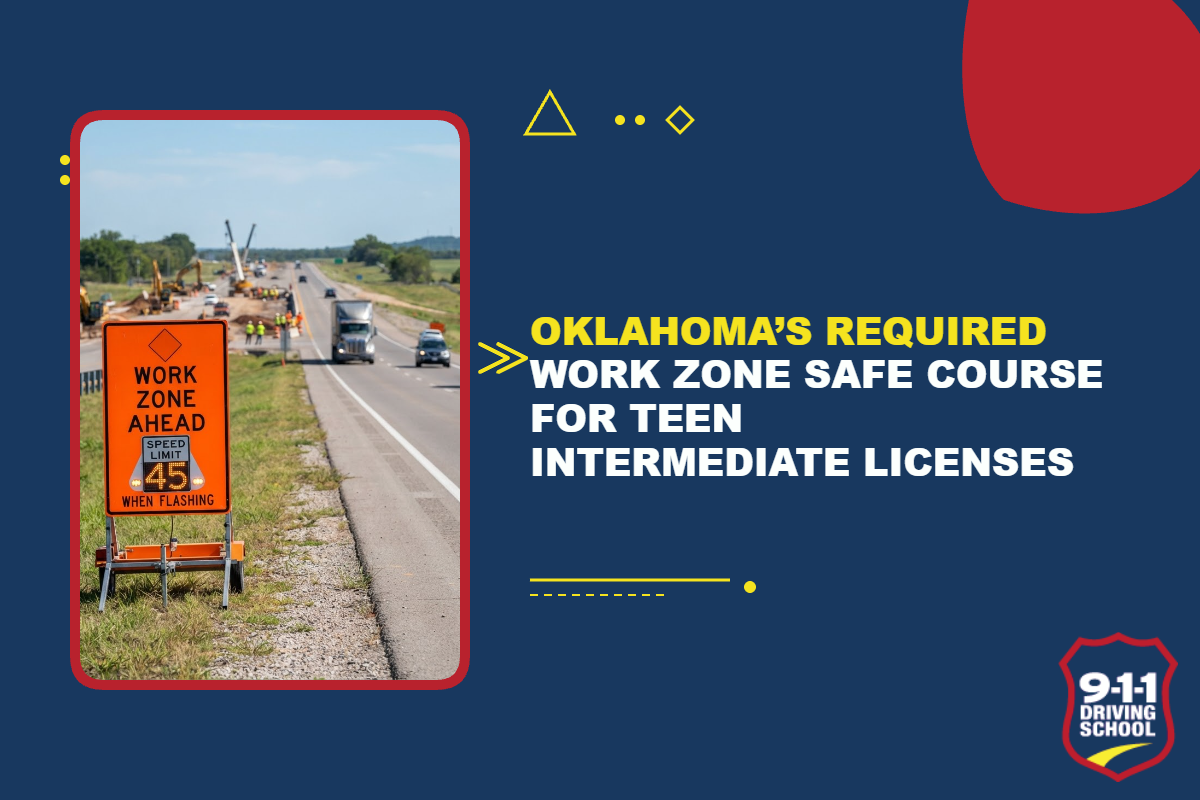
Oklahoma’s required Work Zone Safe course for teen intermediate licenses
Oklahoma teens have one extra step to complete before moving from a learner permit to an intermediate Class D license: the Oklahoma Work Zone Safe Course. The course is free, online and designed to help new drivers understand how to travel safely through construction zones and around first responders.
This requirement is more than a box to check before a road test. Work zones can be confusing for new drivers because traffic patterns change, lanes narrow, workers may be close to moving traffic and signs can appear quickly. A teen who understands work zone signs, flaggers, lane closures, speed changes and move-over expectations is better prepared for real Oklahoma roads.
The rule took effect November 1, 2023. Service Oklahoma announced that Oklahoma became the first state in the nation to require a work zone and first responder safety course for teen drivers before applying for a Class D intermediate license. Families can review the official Service Oklahoma announcement about the Work Zone Safe requirement for the state’s original explanation of the law.
This guide explains who must take the course, when to complete it, what certificate to bring, how the requirement fits into Oklahoma’s graduated driver license system and what new drivers should know before entering a work zone.
What is the Oklahoma Work Zone Safe course?
The Oklahoma Work Zone Safe Course is a free online safety course focused on work zone and first responder safety. It was created to teach teen drivers how their choices behind the wheel affect road workers, emergency responders, passengers and other motorists.
The official course page describes Oklahoma Work Zone Safe as the free course required for teens to receive an Oklahoma intermediate driver license. Service Oklahoma also lists the course as a required item for applicants under 18 who are applying for an intermediate license.
The course is meant to be completed before the teen arrives for the drive test. After finishing the course, the student receives a digital completion certificate. That certificate should be saved, printed when needed and brought to the licensing appointment or drive test visit.
Who has to complete the course?
For licensing purposes, the requirement applies to Oklahoma drivers under 18 who are seeking an intermediate Class D license. Service Oklahoma states on its intermediate license requirements page that applicants under 18 must complete the free online Oklahoma Work Zone Safe Course and bring the completion certificate to the drive test.
The course itself is built for teen drivers, and state and safety-program materials frequently describe the audience as teen drivers ages 15 to 18 or 15 to 19. The key point for families is simple: if the student is under 18 and moving toward an Oklahoma intermediate license, the certificate needs to be completed before the license is issued.
Oklahoma’s enrolled HB 2418 added the requirement that a teen complete a free course approved by the Oklahoma Department of Transportation on teen driver work zone and first responder safety before being issued an intermediate Class D license. Families who want to read the legislative language can review the enrolled version of HB 2418 from the Oklahoma Legislature.
How the course fits into Oklahoma’s graduated driver license process
Oklahoma uses a graduated driver license program to phase in driving privileges for new teen drivers. The state’s Oklahoma teen driving program explains the four phases: student driver, learner permit, intermediate license and unrestricted license.
The Work Zone Safe requirement is connected to the intermediate license stage. A teen does not receive full driving privileges immediately after passing the drive test. Instead, the intermediate license allows more freedom than a learner permit, but it still includes time-of-day and passenger restrictions.
Before applying for an intermediate license, a teen generally needs to meet several requirements:
- Hold a learner permit for 180 days.
- Complete at least 50 hours of behind-the-wheel training with a qualifying licensed driver.
- Make sure at least 10 of those hours are completed at night.
- Have no traffic convictions on the driving record for the required period before the drive test.
- Complete the Oklahoma Work Zone Safe Course and bring the completion certificate.
- Pass the required drive test and meet all document requirements at the licensing visit.
Driver education can also affect timing. According to Service Oklahoma, a teen who has completed driver education may be eligible for an intermediate license at age 16 after holding the learner permit for 180 days. Without driver education completion, the teen must be at least 16 1/2 after holding the learner permit for 180 days.
When should teens complete Work Zone Safe?
The safest answer is early. Service Oklahoma has stated that teens may submit their course completion certificate as early as when applying for a learner permit, but they must have completed it by the time they apply to take the drive test for an intermediate license.
Families should not wait until the night before the drive test. A teen may need time to register, complete every course section, pass the required questions and download the certificate. Waiting until the last minute also creates a problem if the student uses a school email that blocks outside course messages or if the certificate needs to be downloaded again.
A good timeline is:
- Complete the course early during the learner-permit period.
- Download the certificate immediately after finishing the course.
- Email a copy to a parent or guardian.
- Save a digital copy in a folder that is easy to find.
- Print a copy before the drive test appointment.
- Bring the certificate with the learner permit, insurance verification and other required documents.
How long does the course take?
Service Oklahoma’s announcement described the Oklahoma Work Zone Safe Course as taking approximately 45 minutes to complete. The exact time can vary based on the student’s pace, internet connection and whether the student needs to rewatch material or retake a quiz section.
The course is short enough to complete in one sitting, but new drivers should still treat it like a real safety lesson. Rushing through the videos defeats the purpose. The material is meant to prepare teens for work zones they may encounter on highways, city streets, rural roads and near emergency scenes.
What the course is designed to teach
Work zones require drivers to process more information than they may expect. A normal lane may close, traffic may shift onto temporary pavement, workers may be close to the lane, equipment may move nearby and a flagger may replace the usual signal or sign.
The Work Zone Safety Information Clearinghouse overview of Oklahoma Work Zone Safe describes the Oklahoma course as teaching key principles related to safe drivers, signs and laws, and the people behind the work zone. The course is not just about memorizing signs. It is about understanding that each cone, barrel and flag is part of a system built to protect real people.
Students should expect the course to reinforce ideas such as:
- Slow down before entering a work zone.
- Put the phone away and avoid all distractions.
- Watch for orange signs, cones, barrels, barricades and arrow boards.
- Follow flagger directions immediately and carefully.
- Merge early and smoothly when lanes are closing.
- Leave extra room around trucks, road equipment and other vehicles.
- Stay patient when traffic slows or stops.
- Move over and slow down for first responders and emergency scenes.
ODOT’s work zone awareness safety tips give similar guidance for all drivers, including staying alert, setting aside distractions, buckling up, paying close attention to signs and flaggers, avoiding tailgating and planning ahead for delays.
Why Oklahoma added this requirement
Oklahoma added the course because work zones and emergency scenes place inexperienced drivers in high-risk situations. A teen driver may understand the basic rules of the road but still feel unsure when orange signs, narrowed lanes, stopped traffic, uneven pavement, flashing lights or road workers appear suddenly.
The Oklahoma Department of Transportation reported that more than 63,500 teens completed the course during the first year of the law. The same ODOT first-year Work Zone Safe update explains that the program teaches work zone and first responder safety while introducing students to the people behind the flags and flashing lights.
That human element matters. It reminds teens that construction zones are not just delays on the way to school, work or practice. They are workplaces. Every person in the vehicle and every person outside the vehicle is depending on drivers to slow down, stay alert and make careful decisions.
What to do after completing the course
After completing Oklahoma Work Zone Safe, the teen should download the completion certificate. Do not rely only on a confirmation screen. The certificate is the document that proves the course was completed.
Families should take these steps:
- Download the certificate as a PDF file.
- Check that the student’s name appears correctly.
- Save the file to a parent-accessible folder.
- Email a copy to the parent or guardian.
- Print a hard copy for the licensing visit.
- Keep the digital file even after the test in case another copy is requested.
If the certificate is lost, the student should log back into the course account using the same email address used during registration. Families should avoid creating multiple accounts for the same student unless directed by the course provider, because the certificate is tied to the account information used during registration.
What to bring when applying for the intermediate license
The Work Zone Safe certificate is only one part of the intermediate license visit. Service Oklahoma lists several items that may be required once the drive test is scheduled.
A teen should generally be prepared to bring:
- Learner permit
- Proof of residency if changing address
- Proof of insurance or security verification form
- Driver education completion certificate, if applicable
- Parent, legal guardian or notarized affidavit of driver training
- Oklahoma Work Zone Safe Course completion certificate
Because document rules can change and special situations may apply, families should review Service Oklahoma’s current intermediate license checklist before the appointment.
Do not forget the vehicle requirements
A teen can complete the course, bring the certificate and still be unable to test if the vehicle does not meet inspection requirements. The vehicle used for the drive test must have valid registration, valid insurance and required safety equipment in working order.
Service Oklahoma provides a drive test vehicle requirements checklist that covers items such as the license plate, lights, windshield, tires, horn, muffler, brakes, door handles, seat belts and mirrors. Families should inspect the vehicle several days before the test instead of discovering a problem at check-in.
For broader preparation, Service Oklahoma also links families to the official Oklahoma Driver Manual through its driver education resources. The manual is still important because the Work Zone Safe course does not replace knowledge-test preparation, general rules of the road or road-test practice.
Oklahoma intermediate license restrictions still apply
Completing the Work Zone Safe course does not remove intermediate license restrictions. The course is a requirement for the license, but the intermediate stage still limits when and with whom a teen may drive.
According to Service Oklahoma’s intermediate license guidance, intermediate license holders may drive from 5:00 a.m. to 10:00 p.m. The restriction does not apply when the teen is driving to or from school, church or work-related activities, or when accompanied by a licensed driver at least 21 years old in the front seat.
Passenger limits also apply. Service Oklahoma states that an intermediate license holder may drive with one passenger, only household members, or any passenger if accompanied by a licensed driver at least 21 years old in the front seat.
Parents should discuss these rules before the teen begins independent driving. A new driver may remember the road test and the course certificate but forget that the intermediate license is still a restricted license.
Work zone habits every Oklahoma teen driver should practice
The course teaches work zone awareness, but parents should continue reinforcing those habits during supervised driving. Work zone safety improves when teens practice the same behaviors repeatedly in real traffic.
Slow down before the work zone begins
A common mistake is waiting too long to reduce speed. Orange signs usually appear before the most active part of the work zone. The teen should begin scanning early, ease off the accelerator and be ready for vehicles ahead to slow down or stop.
Look far ahead, not just at the car in front
Work zones often create traffic waves. A driver several cars ahead may brake because of a lane closure, flagger or equipment entering the work area. Looking far ahead gives a teen more time to respond smoothly.
Put the phone away before driving
Phones are especially dangerous in work zones because conditions change quickly. ODOT’s safety guidance consistently emphasizes putting away distractions, slowing down and staying focused. A teen should not wait until the vehicle is already in the work zone to silence the phone or set navigation.
Leave more following distance
Work zone traffic may stop suddenly. A larger following distance gives a new driver time to react to braking vehicles, merging traffic, rough pavement and unexpected instructions from flaggers.
Merge when signs direct you to merge
Lane closures can cause stress for new drivers. Teens should read the signs early, signal, check mirrors, find a safe gap and merge smoothly. Cutting in late, speeding past a line of vehicles or hesitating until the lane ends can make the situation harder for everyone.
Watch for flaggers and follow their instructions
Flaggers may control traffic when normal signals or signs are not enough. Their instructions should be followed carefully. A teen should slow down, make eye contact when possible and wait until it is clearly safe to proceed.
Expect uneven pavement and narrow lanes
Construction areas can include pavement edges, temporary lane markings, shifted lanes, barrels close to the vehicle and rough surfaces. New drivers should keep both hands ready, maintain steady lane position and avoid sudden steering movements.
Give trucks and equipment extra room
Large trucks and road equipment need more space to slow down, turn and maneuver. Teens should avoid lingering beside large vehicles, cutting closely in front of trucks or assuming construction equipment will move like a passenger car.
Know what orange signs mean
Orange signs warn drivers that they are entering or approaching a work zone. These signs may communicate lane closures, road work ahead, flaggers, shoulder work, pilot cars, reduced speed zones or changing pavement conditions.
ODOT maintains a page for Oklahoma work zone signs that includes examples such as road work next miles, end road work, pilot car, wait for pilot car, no pavement markings and work zone specialty signs. New drivers should become comfortable recognizing orange signs before they encounter them at highway speed.
A parent can turn work zone sign review into a short practice exercise. During supervised driving, ask the teen to identify the first orange sign, explain what it means and describe what action they will take next. That process builds the habit of seeing signs early and responding before the last second.
How parents can reinforce the course during practice driving
The course gives teens a foundation, but parents are still the daily coaches. The best way to make the training stick is to connect the online course to actual driving experiences.
During practice drives, parents can:
- Point out work zone signs before entering the zone.
- Ask the teen what speed and lane choice would be safest.
- Talk through how to merge when a lane closes.
- Practice leaving extra space behind trucks.
- Review what to do when emergency vehicles or responders are present.
- Model putting the phone away before starting the vehicle.
- Discuss how distractions affect workers, passengers and other drivers.
Parents should avoid turning every work zone into a lecture. A short question before the work zone and a short review afterward are usually more useful than talking continuously while the teen is trying to drive.
Common mistakes families should avoid
Most problems with the course requirement are preventable. Watch for these common mistakes.
Waiting until the day of the drive test
The certificate needs to be ready when the teen applies for the intermediate license. Completing the course early prevents unnecessary stress and reduces the chance of missing a test appointment because a certificate cannot be found.
Using an email address the student cannot access later
A teen should register with an email address that can receive outside messages and be accessed later. Some school email accounts block outside course messages, which can make it harder to retrieve the certificate.
Assuming the certificate replaces other documents
The Work Zone Safe certificate is required, but it does not replace the learner permit, insurance verification, driver training affidavit, driver education completion certificate or other items that may apply.
Forgetting that the intermediate license is restricted
Passing the drive test and completing the course does not mean a teen has unrestricted privileges. Time-of-day and passenger limits still matter.
Treating work zones like normal roads
A work zone changes the driving environment. Teens should expect reduced speeds, temporary signs, closed shoulders, workers nearby, narrow lanes, equipment and sudden stops.
Frequently asked questions
Is Oklahoma Work Zone Safe required for all teen intermediate licenses?
Yes. Service Oklahoma states that a certificate of completion for the free Oklahoma Work Zone Safe Course is required to receive an intermediate license under age 18.
Is the course free?
Yes. The required Oklahoma Work Zone Safe Course is free and online.
When did the requirement start?
The requirement took effect November 1, 2023.
Can a teen complete the course before applying for the learner permit?
Families should follow the current instructions on the official course and Service Oklahoma pages. Service Oklahoma has said teens may submit the certificate as early as when applying for a learner permit, but it must be completed by the time the teen applies to take the drive test for an intermediate license.
Do teens still need 50 hours of supervised driving?
Yes. The course does not replace supervised driving. Service Oklahoma lists at least 50 hours of behind-the-wheel training, including 10 hours at night, as part of intermediate license eligibility.
Does completing the course remove passenger or night restrictions?
No. The course is required to receive the intermediate license, but the intermediate license restrictions still apply until the teen qualifies for an unrestricted license.
What if the student loses the certificate?
The student should log back into the course account using the same registration email and download the certificate again. Families should keep both digital and printed copies to avoid delays.
Does the course replace driver education?
No. The Work Zone Safe course is a separate requirement focused on work zone and first responder safety. It does not replace Oklahoma driver education, learner-permit requirements, road-test preparation or the state driver manual.
Parent and teen checklist
Before the intermediate license visit, make sure the teen has:
- Reviewed Oklahoma’s teen driving process.
- Met the learner-permit holding period and intermediate license eligibility rules.
- Completed 50 hours of supervised driving, including 10 hours at night.
- Had no disqualifying traffic convictions during the required period.
- Completed the Oklahoma Work Zone Safe Course.
- Downloaded and printed the course certificate.
- Collected the learner permit and required paperwork.
- Prepared proof of insurance and vehicle registration.
- Checked the test vehicle against Service Oklahoma’s vehicle requirements.
- Studied the Oklahoma Driver Manual.
- Practiced driving through real work zones with a calm, licensed adult when conditions are safe.
Oklahoma’s Work Zone Safe requirement gives teens a chance to learn one of the most important lessons in driving: the road is a shared space. Work zones are not just about cones, barrels and slower traffic. They involve workers, first responders, families, passengers and other drivers who all depend on safe decisions.
For families, the practical steps are simple. Complete the course early, save the certificate, bring it to the intermediate license visit and keep practicing the habits the course teaches. A teen who slows down, avoids distractions, follows signs, respects flaggers and gives workers room is not only better prepared for the license process. That teen is better prepared for Oklahoma roads.
Official sources and helpful links
- Oklahoma teen driving program
- Oklahoma intermediate license requirements
- Oklahoma Work Zone Safe Course
- Service Oklahoma announcement about the Work Zone Safe requirement
- Enrolled version of HB 2418
- ODOT first-year Work Zone Safe update
- ODOT work zone awareness safety tips
- Oklahoma work zone signs
- Service Oklahoma driver education resources
- Work Zone Safety Information Clearinghouse overview of Oklahoma Work Zone Safe