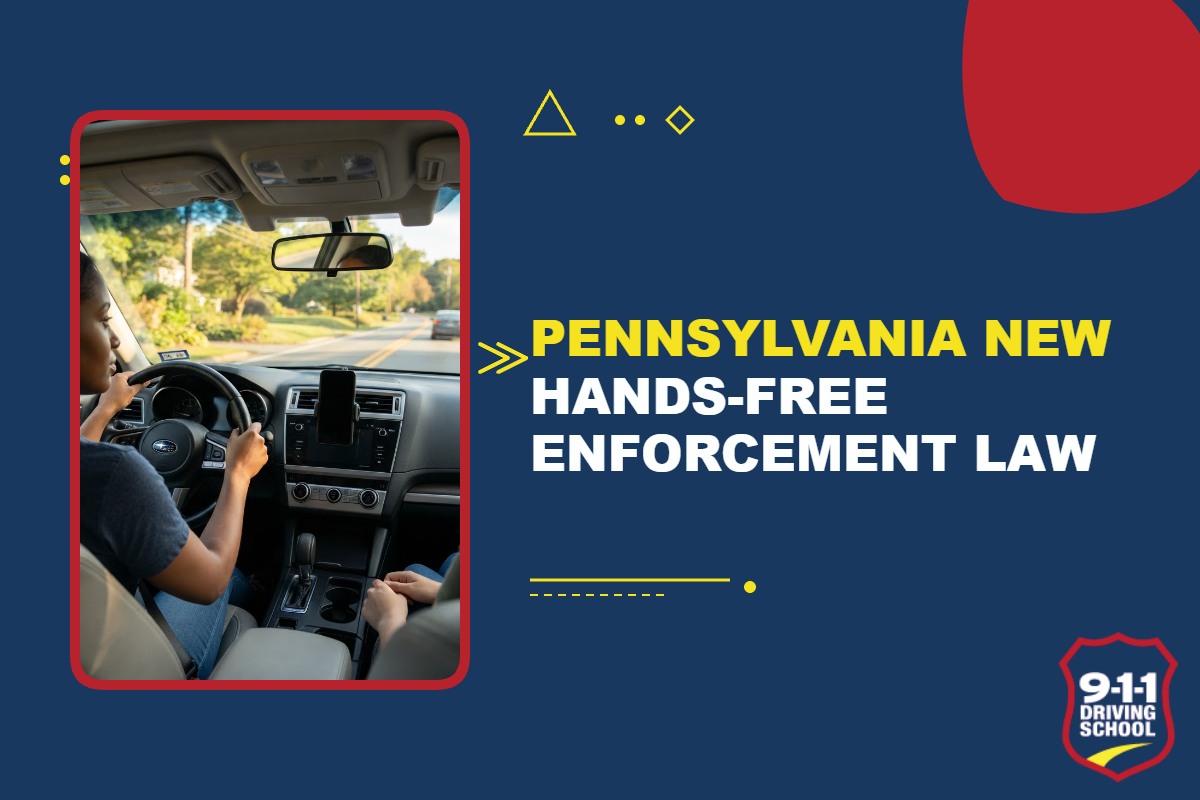
Pennsylvania begins enforcement of Paul Miller’s Law
Pennsylvania’s distracted driving rules changed in a major way when the state moved from warnings to citations under Paul Miller’s Law. For new drivers, the message is simple: do not hold, support, reach for or manually use a phone or other interactive mobile device while driving.
The Pennsylvania Department of Transportation explains that Paul Miller’s Law bans the use of hand-held devices while driving. The law first took effect in 2025 with a warning period, and PennDOT later reminded drivers that fines would begin in June 2026.
For teens and other new drivers, this law matters because distracted driving usually does not feel dangerous until it is too late. A quick glance at a text, a tap on a playlist, or reaching for a phone that slid off the seat can pull your eyes, hands and attention away from the road during the exact moment you need them most.
This guide explains what changed, what the law prohibits, which exceptions apply, how it works with Pennsylvania’s texting-while-driving ban and how new drivers can build safer phone habits before a ticket or crash happens.
Quick overview of Pennsylvania’s Paul Miller’s Law
Here are the key points new drivers should understand first:
- Paul Miller’s Law is Pennsylvania’s hands-free distracted driving law.
- The law prohibits a driver from using an interactive mobile device while driving a motor vehicle, except for specific exceptions.
- It is a primary offense, which means police can stop a driver for the hand-held device violation itself.
- Driving includes being temporarily stopped because of traffic, a traffic light, a stop sign or another momentary delay.
- The warning-only period ended after the first 12 months of the law.
- Beginning June 5, 2026, drivers convicted under the law face a $50 fine, plus court costs and other fees.
- Drivers may still use hands-free technology for phone calls, navigation and music, and may use a device to contact emergency responders.
- Pennsylvania’s separate texting-while-driving ban still applies.
The exact statutory language appears in section 3316.1 of Title 75, which is the section of the Pennsylvania Vehicle Code that prohibits use of an interactive mobile device while driving.
What changed when enforcement began
Paul Miller’s Law was signed in 2024 and took effect on June 5, 2025. For the first 12 months, drivers who violated the hands-free rule could receive a written warning. The state later announced that, beginning June 5, 2026, drivers convicted of using a hand-held device while driving would pay a $50 fine plus court costs and other fees.
That is the practical change new drivers need to understand. The rule is no longer just an awareness campaign or a warning period. A driver who is holding or manually using a covered device behind the wheel may now be stopped and cited.
The law applies to drivers generally, not only to teen drivers. However, it is especially important for teens and first-time drivers because distraction stacks on top of inexperience. New drivers are still learning how to judge gaps, maintain speed, check mirrors, scan intersections and react to mistakes by others. A phone makes all of those skills harder.
Why Pennsylvania passed Paul Miller’s Law
The law is named for Paul Miller Jr., who was killed in a 2010 crash in Monroe County involving a distracted driver. His family, including his mother Eileen Miller, became advocates for stronger distracted driving protections in Pennsylvania.
PennDOT’s 2026 announcement about the fine explains the background of Paul Miller Jr. and the push to reduce distracted driving. The purpose of the law is not simply to punish phone use. It is to reduce preventable crashes caused by drivers who are looking at or handling devices instead of driving.
For new drivers, the safest way to think about the law is this: if the device requires your hand, your eyes or your attention while the car is in traffic, it should wait. The legal rule and the safe-driving rule point in the same direction.
What the law prohibits
Under Pennsylvania’s distracted driving law, a driver may not use an interactive mobile device while driving a motor vehicle, unless a specific exception applies.
This covers more than typing a text message. Paul Miller’s Law focuses on hand-held device use broadly. A driver should not hold a phone, support it with another part of the body, dial or answer by pressing more than one button, or reach for it in a way that forces the driver out of a normal seated, belted driving position.
In everyday terms, do not do these things while driving:
- Hold a phone in your hand.
- Balance or support a phone against your body.
- Dial a number manually by pressing several buttons.
- Answer a device in a way that requires more than a single button press.
- Pick up a phone to check a text, notification, photo, email or social media alert.
- Reach down, across the seat or into a bag for a phone while still driving.
- Hold the phone at a red light to read or respond to a message.
- Scroll, search, type, browse, record, post or watch content while behind the wheel.
What counts as an interactive mobile device
The law uses the term interactive mobile device. That does not mean only a cell phone.
A covered device can include a:
- Handheld wireless telephone.
- Personal digital assistant.
- Portable computer.
- Mobile computer.
- Similar device used for voice communication, texting, email, internet browsing, instant messaging, games, images, video, social media or other electronic data.
The state definition is detailed in the Paul Miller’s Law act text, which updated Pennsylvania’s Vehicle Code language for interactive mobile devices.
For a new driver, it is better not to focus on whether a specific device technically fits one category. If it is a handheld electronic device that can communicate, display messages, browse, record or send data, do not handle it while driving.
What counts as driving
One of the most important parts of Paul Miller’s Law is the definition of driving.
PennDOT explains that driving includes operating a motor vehicle on a highway, including when the vehicle is temporarily stationary because of traffic, a traffic control device or another momentary delay. The same idea appears in the official section 3316.1 definition of driving.
That means a red light is not a phone break. A traffic backup is not a phone break. Waiting at a stop sign, being paused in a lane or sitting in a temporary delay still counts as driving for this law.
To use the phone manually, the safer and clearer approach is to pull out of traffic, move to the side of or off the highway and stop in a location where the vehicle can safely remain stationary.
What drivers can still do
Paul Miller’s Law does not ban every possible use of technology in a vehicle. It targets hand-held and manually distracting device use while driving.
Emergency communication
The law includes an emergency use exception. Drivers may use an interactive mobile device when necessary to communicate with law enforcement or other emergency services to prevent injury to people or property. PennDOT summarizes this on its Pennsylvania distracted driving law page.
Even during an emergency, pull over safely when possible. If you must call 911, keep the call as simple as possible, give your location and follow the emergency operator’s instructions.
Hands-free calls, navigation and music
PennDOT states that drivers can still use hands-free technology to make phone calls, use a GPS and listen to music. The key is that the driver should not be holding or manually operating the device in a way that violates the law or takes attention away from driving.
For new drivers, the safest practice is to set the route, music and do-not-disturb settings before shifting out of park. Hands-free does not automatically mean distraction-free. Voice commands, calls and navigation prompts can still divide your attention, especially on busy roads.
Stopping safely before using the phone
A driver may use a device after moving the vehicle to the side of or off the highway and stopping in a place where the vehicle can safely remain stationary. Do not stop in a travel lane, block traffic or pull into an unsafe shoulder simply to answer a message.
Good places to stop may include a legal parking space, a parking lot, a rest area or another safe location away from moving traffic. Hazard lights do not turn an unsafe stopping location into a safe one.
How Paul Miller’s Law differs from Pennsylvania’s texting ban
Pennsylvania already had a texting-while-driving ban before Paul Miller’s Law took effect. New drivers should understand both rules because they are related but not identical.
Under section 3316 of Title 75, a driver may not use an interactive mobile device to send, read or write a text-based communication while the vehicle is in motion. The statute defines text-based communication to include texts, instant messages, email and other written communication composed or received on an interactive mobile device.
Paul Miller’s Law is broader because it addresses hand-held device use while driving, not only texting. It also makes clear that temporary stops caused by traffic, traffic lights, stop signs or other momentary delays still count as driving.
Here is the practical difference:
- Texting-while-driving law focuses on sending, reading or writing text-based communication while the vehicle is in motion.
- Paul Miller’s Law focuses on holding, supporting, reaching for or manually using an interactive mobile device while driving.
- Paul Miller’s Law can apply even when the vehicle is temporarily stopped because of traffic or a traffic control device.
- Both laws are primary offenses, meaning a driver can be stopped for the device violation itself.
The statutes also say a person may not be charged under both the texting statute and section 3316.1 for an offense committed at the same time and place. That does not make the behavior safe or legal. It simply addresses how citations are handled for overlapping conduct.
Why this matters for teen and new drivers
PennDOT’s young driver safety page identifies driver inexperience, driver distractions, driving too fast for conditions and improper or careless turning as key contributors to crashes involving teen drivers in Pennsylvania.
A new driver is still building muscle memory. They are learning when to brake, how far ahead to scan, how to check mirrors, how to stay centered in the lane and how to anticipate other drivers. Looking down at a phone interrupts that learning process and makes ordinary situations harder.
Distracted driving also creates a dangerous confidence problem. A driver may look at a phone once and get away with it, then repeat the behavior. The absence of an immediate crash does not mean the behavior was safe. It means the driver was lucky.
The Pennsylvania DMV’s teen driver safety tips tell young drivers to focus on the driving task, avoid cell phone use while driving and avoid other distractions such as eating or drinking behind the wheel.
How the law connects to the Pennsylvania learner’s permit process
Paul Miller’s Law also affects driver education and the knowledge test process. The 2024 act added distracted driving awareness language to Pennsylvania’s driver licensing framework.
The Act 18 text for Paul Miller’s Law includes provisions related to distracted driving education materials for young drivers and at least one knowledge-test question about distracted driving. This makes distracted driving a licensing topic, not just an enforcement topic.
Pennsylvania’s online driver manual page for applying for a learner’s permit explains that applicants under 18 must complete supervised behind-the-wheel practice before taking the road test. Those practice hours should include phone-free driving habits from the beginning.
Parents, guardians and instructors should treat phone control as part of every practice drive. Before the vehicle moves, ask: Is the phone put away? Is the route set? Is do-not-disturb turned on? Is the music already chosen? If the answer is no, fix it before driving.
Common situations that can lead to a violation
Most phone violations do not start with a driver deciding to drive recklessly. They usually begin with a small moment of convenience. New drivers should recognize those moments before they become habits.
Checking a message at a red light
A red light may feel like a pause, but Pennsylvania’s law treats temporary stops caused by traffic control devices as part of driving. Keep the phone down until you are legally and safely stopped outside the traffic flow.
Changing music in traffic
Scrolling through a playlist can be just as distracting as reading a message. Choose music before the drive begins. If something needs to change, use safe hands-free controls or wait until you are stopped somewhere safe.
Reaching for a dropped phone
A phone sliding off the seat can trigger a dangerous instinct to reach for it. Do not. Reaching can pull your eyes from the road, move your body out of position and cause the vehicle to drift. Leave it until you can stop safely.
Typing a destination after you start moving
Navigation should be set before you drive. If the route changes or you need a new address, have a passenger handle it or pull over safely before entering information.
Holding the phone on speaker
Putting a phone on speaker does not make it hands-free if you are still holding it. Use a lawful hands-free setup or let the call wait.
Using social media behind the wheel
Reading comments, recording clips, posting stories or checking notifications behind the wheel creates obvious visual, manual and mental distraction. It is also exactly the type of phone-centered behavior new drivers should eliminate early.
A safer phone setup before every drive
The easiest way to follow Paul Miller’s Law is to remove the temptation before the car moves. A simple routine can prevent most problems.
- Set your route before shifting out of park.
- Turn on do-not-disturb while driving or a similar driving mode.
- Choose music, podcasts or audio before leaving.
- Place the phone in a mount, console, bag or other location where you will not hold it.
- Tell friends or family you will respond after you arrive.
- Ask a passenger to handle navigation or messages when appropriate.
- Pull over somewhere safe if a call or message truly cannot wait.
For teen drivers, parents can make this routine part of supervised practice. The goal is to create a habit so strong that driving with a phone in hand feels as wrong as driving without a seat belt.
What to do when the phone rings while driving
When the phone rings or a message comes in, decide in advance what you will do. The worst time to make that decision is when traffic is moving and a notification appears.
Use this order:
- Ignore the call or message until you arrive.
- Use a lawful hands-free option only if the call is necessary and the traffic situation is simple enough to manage safely.
- Ask a passenger to answer or read directions when that is safe and appropriate.
- Pull over to a safe, legal location if the matter cannot wait.
Do not grab the phone because you are worried about being rude. A late reply is better than a crash or citation.
What parents should teach new drivers about the law
Parents and guardians have a major role in making the law practical. A teen may understand the rule but still copy what adults do in the car. Modeling matters.
A parent teaching a teen driver should:
- Put their own phone away when driving.
- Require the teen to set navigation before moving.
- Correct phone handling immediately during practice drives.
- Explain that red lights and traffic backups are not phone breaks.
- Make phone rules part of a written parent-teen driving agreement.
- Review official PennDOT distracted driving information together.
PennDOT also offers resources for parents through its Pennsylvania young driver information, including guidance for supervised practice and teen driver safety.
What to do if you are stopped for a device violation
A traffic stop can be stressful for any driver, especially a new driver. Stay calm, pull over safely, keep your hands visible and follow the officer’s instructions.
If you are cited, read the ticket carefully and follow the instructions for responding by the deadline. The final amount owed may include the $50 fine plus court costs and other fees. If you have questions about a specific citation, court date, license consequence or legal defense, ask a qualified attorney or the court listed on the citation.
For new drivers, the better lesson is to prevent the stop before it happens. Put the phone away every time, even on short trips.
Frequently asked questions about Paul Miller’s Law
Is Pennsylvania now a hands-free state?
Yes. Pennsylvania now prohibits hand-held use of interactive mobile devices while driving, with specific exceptions. The safest way to understand the rule is that drivers should not hold or manually use a phone while driving.
When did citations begin under Paul Miller’s Law?
PennDOT announced that drivers convicted of using a hand-held device while driving would face the fine beginning June 5, 2026. The law had a warning-only period during its first 12 months.
How much is the fine?
The base fine is $50. PennDOT states that court costs and other fees can also apply, so the amount a driver pays may be more than the base fine.
Can police stop me just for holding a phone?
Yes. PennDOT describes the law as a primary offense. That means police can stop a driver for the hand-held device violation itself.
Does the law apply at a red light?
Yes. Pennsylvania defines driving to include being temporarily stationary because of traffic, a traffic control device or another momentary delay. A red light or traffic jam is not a safe legal time to pick up the phone.
Can I use GPS in Pennsylvania?
Drivers can still use navigation, but the safest practice is to set the route before driving and rely on lawful hands-free operation. Do not type a destination, hold the phone or reach for the device while driving.
Can I make a hands-free call?
PennDOT states that drivers can use hands-free technology to make phone calls. New drivers should still limit calls because conversation can distract from scanning, speed control and decision-making.
Can I use my phone for an emergency?
Yes. The law includes an emergency exception for communication with law enforcement or other emergency services when necessary to prevent injury to people or property. Pull over safely when possible.
Can police take my phone during a stop?
The statute says the law should not be construed to authorize seizure or forfeiture of an interactive mobile device unless otherwise provided by law. You can review this wording in Title 75 section 3316.1.
Can I be cited under both Paul Miller’s Law and the texting ban for the same act?
The law says a person may not be charged under both section 3316 and section 3316.1 for an offense committed at the same time and place. That does not make the phone use legal; it addresses overlapping charges for the same conduct.
Does Paul Miller’s Law apply only to teens?
No. The hands-free rule applies to drivers generally. Teen drivers should pay close attention because distracted driving is especially risky while they are still gaining experience.
What is the best habit for new drivers?
Set the phone before the drive, place it out of reach, use do-not-disturb and do not touch it again until the vehicle is safely and legally stopped outside traffic.
Official Pennsylvania resources to review
Drivers, parents and instructors should review the official state resources directly, especially before relying on a rule for a citation, driver education program or licensing decision.
- PennDOT distracted driving and Paul Miller’s Law page
- PennDOT announcement on Paul Miller’s Law fines
- Pennsylvania Vehicle Code section 3316.1
- Pennsylvania Vehicle Code section 3316
- Act 18 of 2024, known as Paul Miller’s Law
- Pennsylvania DMV teen driver safety tips
- PennDOT young driver safety resources
- Pennsylvania online driver’s manual chapter on driver factors
Pennsylvania’s enforcement of Paul Miller’s Law gives new drivers a clear rule to follow: keep the phone out of your hands while driving. The law covers more than texting, and it applies even when you are stopped temporarily at a light or in traffic.
For teen drivers, the safest routine is also the simplest. Set up the phone before the vehicle moves. Put it away. Let calls and messages wait. Pull over safely if something truly cannot wait.
Good driving depends on attention. Paul Miller’s Law reinforces a habit every new driver needs from the beginning: eyes on the road, hands on the wheel and mind on the drive.