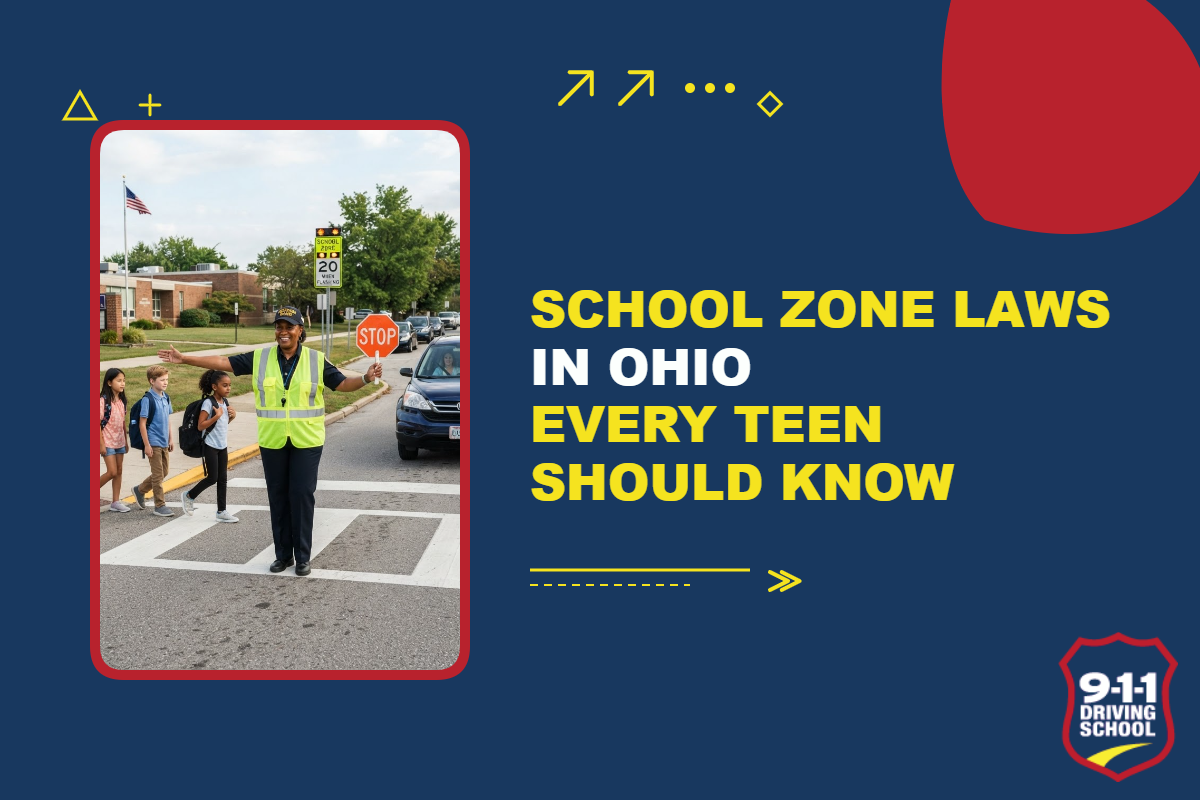
School zone laws in Ohio every teen should know
Driving near a school is different from driving on an ordinary neighborhood street. The speed limit may change, buses may stop suddenly, crossing guards may step into the roadway, and students can appear from between parked cars with very little warning. For a new driver, that combination can feel stressful, especially during morning drop-off or afternoon pickup.
Ohio expects drivers to slow down, obey signs, stop for school buses when required and watch carefully for children walking or biking near schools. These rules matter for every driver, but they are especially important for teens because one mistake in a school zone can lead to a ticket, a license issue, a crash or a dangerous close call.
This guide explains the most important Ohio school zone laws for new drivers, including the 20 mph school-zone speed rule, when to stop for a school bus, how to handle crosswalks and crossing guards, and why phone use is especially risky for teen drivers near schools. For official study material, teens should also review the Ohio Driver Manual from the Ohio Bureau of Motor Vehicles.
Start with the main Ohio school zone speed rule
The first rule every teen should remember is simple: slow down before you enter a school zone, not after you are already in the middle of it.
Ohio’s school-zone speed-limit law generally sets a 20 mph speed limit in school zones during school recess and while children are going to or leaving school during opening or closing hours, when 20 mph school speed limit signs are posted.
That wording is important. A school zone is not active all day in every location just because a school building is nearby. The reduced speed limit applies based on the signs, the school schedule, recess periods and the presence or movement of children during arrival and dismissal times.
When the 20 mph school-zone speed limit applies
A teen driver should treat a school zone as active when the posted school-zone sign or flashing beacon tells drivers to slow down, or when children are clearly arriving, leaving or crossing near the school during normal school hours.
Common situations include:
- Morning arrival when students are walking, biking, being dropped off or crossing streets.
- Afternoon dismissal when students are leaving school and traffic is heavy.
- Recess periods when children may be outside or crossing near school property.
- Times when a posted sign says the school speed limit is in effect during restricted hours.
- Times when school-zone lights are flashing, if that location uses flashing beacons.
Do not wait until you see a child directly in front of the car to begin slowing. By then, it may be too late to stop smoothly. The safer habit is to scan ahead for school signs, begin easing off the accelerator early and be prepared to brake.
Flashing lights are helpful, but they are not the only thing that matters
Many drivers assume that a school zone only counts when lights are flashing. That can be a costly mistake. Ohio law says school zones are not required to have flashing lights or special notice of the hours when the school-zone speed limit is in effect.
Teens should read the entire sign. Some signs show a specific time range. Others say the limit applies during restricted hours or when children are present. If you are unsure whether the zone is active, choose the safer speed and give yourself more stopping distance.
The Ohio Driver Manual section on traffic signs also shows a school speed-limit sign as a regulatory sign, meaning it gives notice of a traffic law or rule that drivers are expected to follow.
Why school-zone speeding is more serious than ordinary speeding
Speed affects both reaction distance and braking distance. At school-zone speeds, a driver has more time to notice a child, a crossing guard, a car door opening or a school bus stopping ahead. At higher speeds, there is less time to react and the consequences of a crash are much worse.
Ohio law also treats certain school-zone speeding more seriously. Under the same Ohio speed-limit statute, driving faster than 35 mph in a school zone during recess or while children are going to or leaving school during opening or closing hours can carry a higher offense level than a basic minor speeding violation.
For a teen driver, the bigger point is this: the school-zone speed limit is not a suggestion. It is a safety rule designed for places where children may act unpredictably.
Obey every school-zone sign and traffic-control device
School zones often include more than a speed-limit sign. A driver may see stop signs, yield signs, no-turn signs, one-way signs, lane markings, crosswalk markings, flashing beacons, overhead signals, cones or temporary signs used during construction or special school events.
Ohio’s traffic-control device law says drivers and pedestrians must obey official traffic-control devices unless a police officer is directing traffic differently. For a teen driver, that means school signs should be treated as instructions, not background scenery.
In a school zone, look specifically for:
- School speed-limit signs and flashing beacons.
- Marked crosswalks and school crossing signs.
- Stop signs near driveways, parking lots and side streets.
- Do not enter signs near one-way school loops.
- No parking or no stopping signs near pickup lines.
- Turn restrictions around bus lanes or student drop-off areas.
- Temporary signs used for construction, events or traffic-control changes.
Do not copy the behavior of another driver who appears to ignore a sign. The driver in front of you may be wrong, distracted or familiar with a local routine that does not apply to your lane. Read the signs yourself and make your own safe decision.
Know when to stop for a school bus in Ohio
School bus laws are one of the most important parts of school-zone driving. A school bus does not have to be directly in front of a school building for the law to matter. A bus stop on a neighborhood road can be just as important as a bus loading area near campus.
Under Ohio’s school-bus stopping law, a driver who meets or overtakes a school bus from either direction must stop at least 10 feet from the front or rear of the bus when the bus is stopped to pick up or drop off children. The driver may not proceed until the bus begins moving again or the bus driver signals the driver to proceed.
The Ohio Department of Education and Workforce also maintains Ohio laws and administrative rules for pupil transportation for school transportation, which are useful for understanding why school bus procedures are designed to be strict and predictable.
Yellow lights on a school bus mean prepare to stop
When a school bus driver is preparing to stop, the bus may display amber or yellow warning lights. Other vehicles are not required to stop while only the amber lights are flashing, but a teen driver should immediately prepare to stop.
Do not try to “beat” the red lights or pass the bus before it stops. That is exactly the kind of rushed decision that can put a child in danger. Ease off the accelerator, check your mirrors and prepare to stop smoothly.
Red lights mean stop
When the bus is fully stopped, the red lights flash and the stop arm may extend. Ohio law still requires a stop even if there is no stop arm. The key fact is that the school bus is stopped for the purpose of receiving or discharging children.
Stop at least 10 feet from the front or rear of the bus. Stay stopped until the bus resumes motion or the school bus driver signals that you may proceed. Do not start moving just because one child has crossed. Another student may still be approaching, running late or hidden from view.
Roads with fewer than four lanes
On a street or road with fewer than four lanes, traffic approaching the stopped school bus from either direction must stop. This includes the driver behind the bus and the driver approaching from the opposite direction.
A two-lane residential street is the easiest example. If the bus is stopped with red lights flashing, both directions stop.
Roads with four or more lanes
On a highway or road divided into four or more traffic lanes, Ohio law says drivers approaching from the opposite direction do not need to stop for the school bus. Drivers overtaking the bus from behind must still stop.
New drivers should be careful with this rule. Count actual traffic lanes, not turning lanes or shoulders, and always watch what the bus, children and nearby traffic are doing. If the situation is confusing, slow down and be prepared to stop.
School bus violations can be expensive and serious
A school bus violation can lead to a fine of up to $500 and a possible license suspension. Ohio law also requires a person cited for unlawfully passing a stopped school bus to appear in court rather than simply mailing in a written guilty plea and waiving the court appearance.
For a teen driver, that kind of violation can also create problems with parents, insurance and the privilege of driving independently. The safest rule is simple: when a school bus is stopped with red lights flashing, stop and wait.
Yield to students and pedestrians in crosswalks
School zones usually have heavy pedestrian traffic. Some students walk with adults. Others walk in groups, look at phones, hurry to catch a bus or step into a crosswalk without understanding how long it takes a vehicle to stop.
Ohio’s pedestrian crosswalk right-of-way law requires drivers to yield, slowing down or stopping if needed, to a pedestrian crossing within a crosswalk when traffic signals are not in place, not operating or not clearly assigning right-of-way, and the pedestrian is on the driver’s half of the roadway or approaching closely enough from the opposite half to be in danger.
The same law also says a driver approaching from the rear may not overtake and pass another vehicle that has stopped at a marked or unmarked crosswalk to allow a pedestrian to cross. That rule is especially important near schools because a stopped vehicle may be blocking your view of a child in the crosswalk.
Do not assume a student sees you
A student may look in your direction without actually recognizing the risk. Younger students may not judge speed or distance well. Teens walking to school may be distracted by friends, earbuds or phones.
A safe teen driver should:
- Slow before the crosswalk, not in the middle of it.
- Check both sides of the street and the sidewalks.
- Watch for students emerging from behind parked cars or buses.
- Avoid waving a pedestrian across if other lanes of traffic may not stop.
- Wait until the pedestrian has cleared your lane and the path is safe before moving.
Understand that pedestrians also have responsibilities
Ohio’s pedestrian right-of-way rule outside crosswalks says pedestrians crossing outside a marked crosswalk or outside an unmarked crosswalk at an intersection must yield to vehicles. But that does not give a driver permission to ignore a person in the roadway. The law also says drivers must exercise due care to avoid colliding with pedestrians.
In a school zone, the practical rule is to expect mistakes from people on foot and leave extra space. Even when a pedestrian should have waited, the driver still has to do everything reasonable to avoid a crash.
Follow crossing guards and school traffic staff
Crossing guards are there because children need help moving safely through traffic. If a guard steps into the road, raises a stop paddle or signals drivers to wait, stop and remain stopped until the guard clears the crossing and it is safe to proceed.
The Ohio Driver Manual tells drivers to obey crossing guards at intersections near schools. For a teen driver, this is one of the easiest ways to avoid a dangerous misunderstanding: when a crossing guard is present, give that person your full attention.
Do not roll forward while students are still crossing. Do not edge into the crosswalk to show that you are ready to go. Do not gesture impatiently at students or guards. A few extra seconds are not worth risking someone’s safety.
Put the phone away before entering a school zone
A school zone is one of the worst places to be distracted. Drivers need to watch the road, sidewalks, crosswalks, buses, signs, parked cars and other drivers all at the same time. Looking down for even a moment can mean missing the one hazard that matters.
Ohio has a general hands-free distracted driving law that prohibits drivers from using, holding or physically supporting an electronic wireless communications device while driving, subject to listed exceptions.
Ohio also has a separate electronic device law for drivers under 18. It prohibits a driver under 18 with a temporary instruction permit and any holder of a probationary driver’s license from driving while using an electronic wireless communications device in any manner. Exceptions include emergency use, use while the vehicle is stationary outside a lane of travel, and voice-operated or hands-free navigation that is not manipulated while driving.
Violating the under-18 device law can result in a $150 fine and a 60-day license or permit suspension for a first violation. A later violation can result in a $300 fine and a one-year suspension.
For school zones, the best habit is to set navigation before leaving, silence the phone and place it somewhere you cannot reach while driving. If something urgent comes up, pull completely out of the lane of travel before using the device.
Use extra care around drop-off and pickup lines
School parking lots and pickup lines are full of movement. Cars stop unexpectedly, doors open into traffic, students cross between vehicles and parents may make sudden turns when they realize they are in the wrong lane.
Local schools may have specific traffic patterns, but the same safe-driving habits apply everywhere:
- Follow posted one-way arrows and lane signs.
- Do not block crosswalks, sidewalks, fire lanes or bus lanes.
- Do not pass a line of stopped vehicles unless a staff member or officer clearly directs you to do so.
- Yield to pedestrians even when they are not where you expected them to be.
- Keep your speed low enough to stop immediately.
- Avoid backing unless you have checked carefully in all directions.
- Watch for younger students who may be shorter than your hood or trunk line.
If you are a teen driver dropping off a sibling or arriving at school, give yourself enough time so you are not tempted to speed, weave through traffic or make a last-second turn.
Be careful near parked cars and school driveways
Children near schools often appear from places where drivers have limited visibility. Parked cars, buses, delivery vehicles, snow piles, landscaping and building corners can all hide pedestrians.
As you pass a row of parked vehicles, look for clues that someone may enter the roadway:
- A car door opening.
- A backpack or shoes visible under a parked vehicle.
- A group of students gathering at the curb.
- A driver waving to a child from across the street.
- A rolling ball, dropped item or pet near the roadway.
- Brake lights or reverse lights from cars in the pickup line.
Cover the brake in crowded areas. That means moving your foot near the brake pedal so you can stop quickly if the situation changes.
Do not pass in unsafe school-zone situations
Passing near a school can be risky even when it seems technically possible. A stopped car may be letting a student cross. A bus may be preparing to activate its lights. A driver may be waiting for a parking space or following instructions from school staff.
Never pass:
- A stopped school bus with red lights flashing.
- A vehicle stopped for a pedestrian in a crosswalk.
- A vehicle stopped for a crossing guard.
- A line of cars in a school pickup or drop-off lane.
- Near a crosswalk when you cannot clearly see both sides of the street.
- When signs, markings or cones indicate that the lane is closed or restricted.
Passing may save only a few seconds, but it can create a serious hazard for someone you cannot see.
How school-zone mistakes can affect a teen driver
A ticket in a school zone is not just a payment problem. For a teen, it can affect parental trust, insurance costs and driving privileges. Ohio’s probationary license restrictions also show how moving violations can lead to additional restrictions for younger drivers in certain situations.
School-zone mistakes that can cause trouble include:
- Speeding through an active school zone.
- Ignoring a stop sign or traffic-control device.
- Failing to stop for a stopped school bus.
- Failing to yield to a pedestrian in a crosswalk.
- Using a phone or electronic device while driving.
- Passing a stopped vehicle at a crosswalk.
- Driving aggressively in a pickup or drop-off line.
Ohio’s distracted-driving penalty rule can also add penalties when a driver commits certain traffic violations while distracted and the distraction contributes to the violation. The safer approach is to treat the school zone as a no-distraction area every time.
Safe school-zone driving habits for teens
Good school-zone driving is not about one trick. It is a pattern of small safe decisions repeated every day.
Scan early
Look far enough ahead to see signs, flashing lights, buses, crosswalks and traffic backups before you reach them. New drivers sometimes stare only at the car directly in front of them. In a school zone, that is not enough.
Slow smoothly
Do not slam on the brakes at the school-zone sign. Begin reducing speed early so the driver behind you has time to react. Smooth slowing also gives you more time to process what is happening around the school.
Leave more following distance
The car ahead may stop for a child, a bus, a crosswalk or a staff member directing traffic. Leave enough space that you can stop without swerving.
Keep both hands and eyes available
A drink, phone, food wrapper, backpack or stereo control can become a distraction. Finish adjusting everything before you reach the school zone.
Expect the unexpected
Children do not always follow traffic rules perfectly. A new driver should expect quick changes and be ready to stop.
Practice plan for new drivers
Parents and teens can practice school-zone driving without making the first experience a stressful morning drop-off. Start when school is not in session and build from there.
- Drive the route on a weekend and identify the school-zone signs, crosswalks, bus lanes and one-way areas.
- Practice reducing speed smoothly before the school-zone sign.
- Practice scanning sidewalks and parked cars while maintaining lane position.
- Return during a quieter school time, such as midday, to see how the area changes when students or staff are present.
- Practice during normal arrival or dismissal only after the teen can handle the route calmly.
- Review any mistakes after the drive, not while the teen is already overwhelmed in traffic.
A teen who drives the route several times with coaching will be more prepared than a teen who encounters the school zone for the first time alone.
Ohio school zone checklist for teen drivers
Before and during every trip through a school zone, use this quick checklist:
- I know where the school zone begins.
- I have checked the posted speed limit and any restricted hours.
- I am ready to slow to 20 mph when the school zone is active.
- My phone is away and I am not using an electronic device.
- I am watching sidewalks, crosswalks and school driveways.
- I know what to do if a school bus shows yellow lights.
- I know when red school-bus lights require me to stop.
- I will stop for crossing guards and pedestrians.
- I will not pass stopped vehicles near crosswalks.
- I will leave extra following distance and avoid rushing.
Frequently asked questions about Ohio school zone laws
What is the speed limit in an Ohio school zone?
Ohio’s school-zone speed limit is generally 20 mph during school recess and while children are going to or leaving school during opening or closing hours, when 20 mph school speed-limit signs are posted. Always follow the posted sign at the specific location.
Does an Ohio school zone have to have flashing lights?
No. Ohio law does not require school-zone signs to have flashing lights or other special notice of the hours when the school-zone speed limit is in effect. Drivers should read the posted signs and watch for children.
Do I have to stop for a school bus on a two-lane road?
Yes. On a road with fewer than four lanes, traffic approaching the stopped school bus from either direction must stop when the bus is stopped to pick up or drop off children.
Do I have to stop for a school bus on a road with four or more lanes?
If you are traveling in the same direction as the bus, you must stop behind it. If you are traveling in the opposite direction on a road with four or more traffic lanes, Ohio law says you do not need to stop for the bus. Slow down and stay alert anyway because children may still be nearby.
How far from a stopped school bus do I have to stop in Ohio?
Ohio law requires drivers to stop at least 10 feet from the front or rear of a stopped school bus when the bus is receiving or discharging children.
Can a teen driver use a phone in an Ohio school zone?
A teen under 18 with a temporary instruction permit and any holder of a probationary driver’s license may not drive while using an electronic wireless communications device in any manner, with limited exceptions. That rule applies everywhere, not only in school zones.
Do drivers have to yield to students in crosswalks?
Yes. Drivers must yield, slowing or stopping if needed, to pedestrians in a crosswalk when the law requires it. Near a school, drivers should be extra cautious because children may be harder to see and less predictable.
Can I pass a car that is stopped at a school crosswalk?
No. Ohio law says a driver approaching from the rear may not overtake and pass another vehicle that has stopped at a marked crosswalk or unmarked crosswalk at an intersection to allow a pedestrian to cross.
What should I do if I am unsure whether a school zone is active?
Slow down, read the signs and watch for children. If you are uncertain, choosing the safer speed is better than assuming the school-zone rules do not apply.
Final thoughts on school zone laws in Ohio
School-zone driving is a test of patience, attention and judgment. Teen drivers do not need to be perfect, but they do need to be prepared. The most important habits are simple: slow down early, obey the signs, stop for buses when required, yield to pedestrians, follow crossing guards and keep the phone away.
Every school zone is built around the same idea: children need extra protection near the places where they learn, walk, ride and wait for buses. When a teen driver treats that area with extra care, they protect students, reduce their own risk and build the kind of driving habits that matter long after the license test is over.