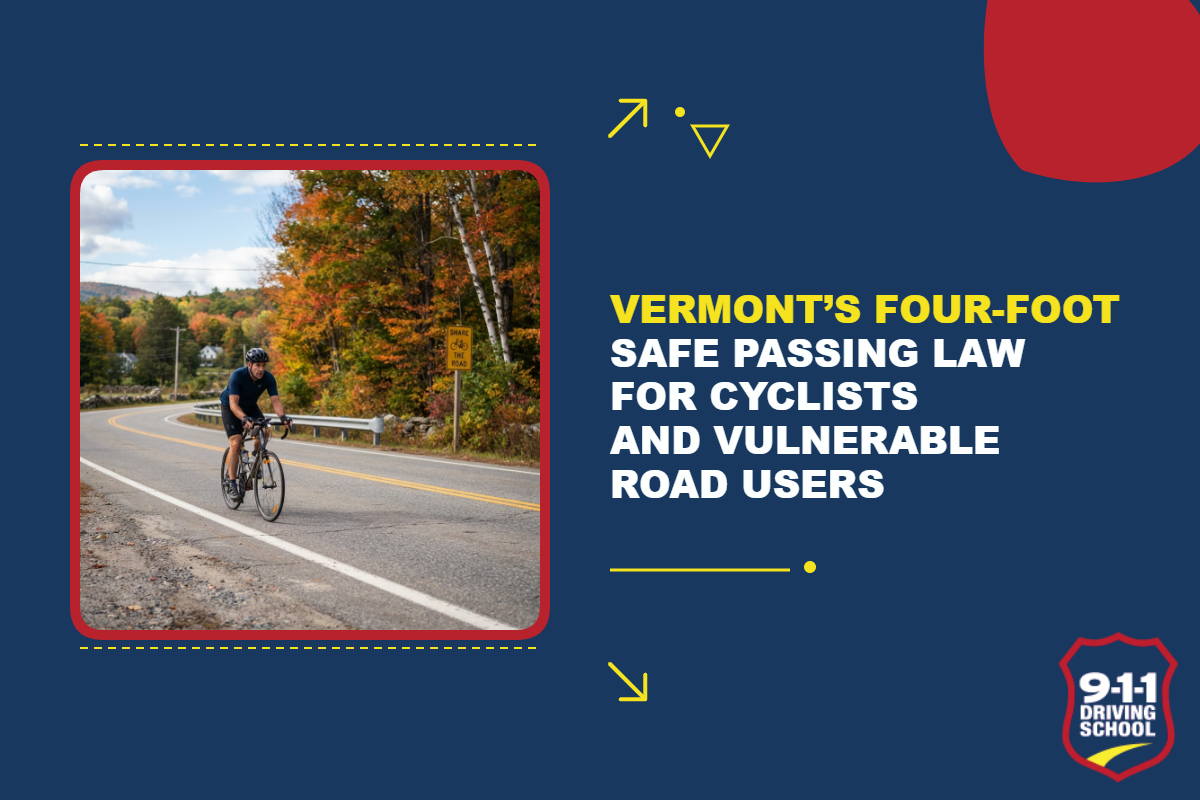
Vermont’s four-foot safe passing law for cyclists and vulnerable road users
Vermont roads can be beautiful, narrow, rural and busy all at the same time. For new drivers, that combination makes one rule especially important: give cyclists and other vulnerable road users enough space when passing.
Under Vermont law, drivers must use due care when approaching or passing a vulnerable user. That includes slowing down and increasing clearance to at least four feet. The rule is not just a courtesy. It is part of Vermont’s motor vehicle law and applies to more than bicycles.
This guide explains how Vermont’s four-foot safe passing law works, who counts as a vulnerable user, when a driver may cross the centerline to pass and what new drivers should practice before they encounter a cyclist, pedestrian, road worker or horse on a narrow Vermont road.
What Vermont law says about passing vulnerable users
The main rule appears in the Vermont passing motor vehicles and vulnerable users law. It says a person operating a motor vehicle who is approaching or passing a vulnerable user must exercise due care. The law explains that due care includes reducing speed and increasing clearance to a distance of at least four feet so the driver can pass safely.
That means a safe pass is not only about steering a few inches farther left. The driver also needs to reduce speed, judge whether there is enough room, check for oncoming traffic and wait when the pass cannot be made safely.
The same statute provides a civil penalty of not less than $200 for a violation. New drivers should treat the rule as both a safety requirement and a legal requirement.
The four-foot language was strengthened through Act 165 of 2024, which updated several Vermont motor vehicle laws related to pedestrians, bicycle operators and vulnerable users. Drivers should use the current statute as the controlling source for the rule.
Who counts as a vulnerable user in Vermont?
Vermont’s safe passing rule is broader than many new drivers expect. The Vermont definition of vulnerable user includes several kinds of people who may be on or near the roadway without the protection of a passenger vehicle.
In plain language, vulnerable users can include:
- Pedestrians
- People operating highway building, repair or maintenance equipment
- People operating agricultural equipment
- People using wheelchairs or other personal mobility devices, whether motorized or not
- People operating bicycles or other nonmotorized transportation, such as roller skates, rollerblades or roller skis
- People operating motor-assisted bicycles or electric bicycles
- People riding, driving or herding an animal
For everyday driving, this means the four-foot rule is not limited to a person on a road bike. It may apply when you are passing a walker on a rural shoulder, a person using a wheelchair near the edge of the road, a farm worker, a road maintenance worker, a person on an e-bike or someone riding a horse.
Why the four-foot rule matters for new drivers
A new driver may understand the law in theory but still struggle when the road is narrow, the cyclist is moving slowly and a vehicle is approaching from the opposite direction. The right answer is simple: slow down, wait and pass only when you can leave enough space.
Cyclists and pedestrians can move unexpectedly because of potholes, gravel, drainage grates, debris, uneven shoulders, parked cars, animals, wind, puddles or ice. A person on a bike may need to move left to avoid a hazard that a driver does not notice from behind. A four-foot buffer gives both people more room to react.
The official Vermont Driver’s Manual teaches new drivers to look for hazards and share the road safely. The four-foot passing rule should become part of that same habit: scan ahead, adjust speed early and leave a predictable amount of space.
How to pass a cyclist or vulnerable user safely in Vermont
A safe pass should feel calm and controlled. If you feel rushed, squeezed or unsure, you are probably not ready to pass.
Use this step-by-step process:
- Notice the vulnerable user early. Look far ahead so you have time to react before you are close behind the person.
- Reduce speed. Slowing down is part of the legal due-care requirement and gives you more time to judge the situation.
- Check mirrors and the road ahead. Look for oncoming vehicles, pedestrians, cyclists, hills, curves, intersections and driveways.
- Decide whether you can leave at least four feet. If not, do not try to squeeze through.
- Signal if you need to move left. A smooth signal helps drivers behind you understand why you are slowing or changing position.
- Pass with a steady path. Do not drift toward the cyclist or cut back too soon.
- Return only when safely clear. Make sure the vulnerable user remains safely behind your vehicle before moving back into your lane.
The pass should never depend on the vulnerable user holding a perfectly straight line. Give enough room for ordinary movement and road conditions.
When a driver should wait instead of passing
One of the hardest lessons for new drivers is that waiting is sometimes the safest and most lawful choice. Passing a cyclist or other vulnerable user is not required just because the driver behind you is impatient.
Wait when:
- You cannot leave at least four feet of clearance.
- There is oncoming traffic close enough to create a conflict.
- You are approaching a hill or curve where your view is limited.
- You are approaching or entering an intersection.
- You are approaching a railroad crossing.
- The road narrows because of a bridge, construction area or parked vehicles.
- The vulnerable user is moving unpredictably or avoiding a hazard.
- Weather, snowbanks, darkness or glare make it harder to judge clearance.
A delay of a few seconds is better than forcing a close pass. For a new driver, patience is not a weakness. It is part of safe vehicle control.
Can you cross the centerline to pass a cyclist in Vermont?
In some situations, a driver may need to move left of the center of the road to give a cyclist or vulnerable user the required space. Vermont law allows that only when the passing movement can be completed safely and only under the limits explained in the Vermont limitations on passing.
The key idea is that the left side of the roadway must be clearly visible and free of oncoming traffic and vulnerable users for enough distance to complete the pass safely. If the pass uses a lane for traffic coming from the opposite direction, the driver must return to an authorized lane before coming within 200 feet of an approaching vehicle or vulnerable user.
Do not cross the centerline to pass when the view is blocked, when you are near a hill or curve, when you are near an intersection or railroad crossing, or when the available gap is not clearly safe. The four-foot rule does not give a driver permission to make a risky pass.
Places where passing can become dangerous quickly
Vermont has many roads where sight distance changes quickly. A driver may see a cyclist, begin to pass and then suddenly face oncoming traffic because of a curve, hill or driveway. That is exactly why the law requires due care and why new drivers should avoid rushed decisions.
Be especially cautious around:
- Crests of hills
- Curves with limited sight distance
- Narrow bridges
- Tunnels or underpasses
- Railroad crossings
- Intersections and side roads
- Driveways hidden by trees, buildings or hills
- Roads with snowbanks, gravel shoulders or drainage ditches
If you cannot see far enough ahead to know the pass is safe, stay behind the vulnerable user at a respectful distance and wait for a better location.
How Vermont bicycle roadway rules affect drivers
New drivers sometimes become confused when a cyclist is not hugging the edge of the roadway. Vermont law does generally direct bicyclists to ride as near to the right side of the improved area of the highway right-of-way as is safe, but that rule has important exceptions.
The Vermont bicycle roadway rules recognize that a bicyclist may need to ride farther left when preparing for a left turn, approaching an intersection with a right-turn lane when not turning right, overtaking another vulnerable user or avoiding hazards and unsafe road conditions.
Those hazards can include objects in the road, parked or moving vehicles, pedestrians, animals, surface conditions, narrow roads, steep embankments, road geometry and unfavorable weather. A cyclist riding away from the edge of the pavement may be avoiding a hazard you cannot see from behind.
For drivers, the takeaway is simple: do not crowd the cyclist. Slow down, give at least four feet and wait until the pass is safe.
What about cyclists riding two abreast?
Vermont law also addresses bicyclists riding next to each other. In general, bicyclists may not ride more than two abreast except on paths or parts of roadways set aside for bicycle use, or as otherwise permitted for certain events. Riders traveling two abreast must not impede the normal and reasonable movement of traffic and, on a laned roadway, should ride within a single lane.
A driver should still apply the same passing analysis. If two riders are present, slow down and wait until you can pass with the required space and a clear view. Do not use the horn aggressively or attempt to force the riders to the edge of the road.
Vermont law also prohibits crowding and harassment
Safe passing is not the only rule that protects vulnerable users. The Vermont crowding and harassment law says a driver may not, in a careless or imprudent manner, approach, pass or maintain speed unnecessarily close to a vulnerable user. It also prohibits an occupant of a vehicle from throwing an object or substance at a vulnerable user.
For new drivers, this matters because unsafe behavior is not limited to physical contact. Tailgating a cyclist, buzzing past a pedestrian, accelerating near a horse or yelling out the window can create fear and danger even when there is no crash.
The right approach is predictable and respectful driving: slow down, leave space and avoid any behavior that pressures the vulnerable user.
How to handle narrow rural roads
Many Vermont roads were not designed with wide paved shoulders. On these roads, a driver may have to wait behind a cyclist, pedestrian or horse until a clear and legal passing area appears.
Use these habits on narrow roads:
- Ease off the accelerator early instead of braking hard at the last second.
- Stay back far enough that you are not pressuring the vulnerable user.
- Look beyond the vulnerable user for oncoming traffic, curves, driveways and road signs.
- Avoid creeping up beside the person while waiting for a gap.
- Pass only when you can make one smooth, complete movement with at least four feet of clearance.
- Be ready to abandon the pass if conditions change before you move left.
On a narrow road, the safest pass may require crossing part of the centerline. That is only appropriate when the left side is clearly visible and clear, and when Vermont’s passing limitations allow it.
How to pass pedestrians and people using mobility devices
The four-foot safe passing rule is often discussed in relation to bicycles, but it can also apply to pedestrians and people using wheelchairs or other mobility devices. This is especially important on roads without sidewalks.
When approaching a person walking along the roadway:
- Slow down early.
- Move over only when it is safe and lawful.
- Leave at least four feet of clearance.
- Watch for dogs, children, uneven shoulders or sudden movement.
- Do not splash pedestrians by driving quickly through standing water.
The Vermont pedestrian safety and vulnerable road user toolkit emphasizes that communities, drivers, schools and local organizations all play a role in improving safety for people who walk and bike. New drivers can do their part by making careful passing a daily habit.
How to pass people on horses or near animals
Vermont’s vulnerable user definition also includes a person riding, driving or herding an animal. Drivers should be especially careful around horses because they can react to sudden noise, close vehicles or fast movement.
When passing a horse or animal handler:
- Slow down well before you reach them.
- Do not rev the engine or honk unless necessary to prevent immediate danger.
- Give more than the minimum space when possible.
- Pass at a calm and steady speed.
- Watch the rider or handler for signals.
- Be patient if the animal needs time to settle or move to a safer position.
A horse may move sideways without warning. A cautious driver leaves enough space and avoids sudden acceleration.
How weather changes the safe passing decision
Vermont weather can make passing decisions more complicated. Rain, snow, fog, glare and darkness can reduce visibility and make shoulders less usable for vulnerable users.
In poor weather, new drivers should increase caution by:
- Slowing earlier than usual.
- Increasing following distance behind the vulnerable user.
- Waiting longer for a clear passing area.
- Leaving more than four feet when possible.
- Watching for puddles, ice, sand, gravel and snowbanks.
- Avoiding quick steering movements on slippery pavement.
The legal minimum does not always equal the safest choice. Four feet is the required clearance, but weather, road surface and traffic may call for more space.
Common mistakes new drivers make around cyclists
Most unsafe passes happen because a driver misjudges time, speed or distance. New drivers should watch for these common mistakes:
- Passing too closely because the driver is afraid to cross the centerline.
- Passing too quickly because the driver wants to spend less time near the cyclist.
- Trying to pass before a hill or curve without enough sight distance.
- Moving back right too soon after passing.
- Assuming the cyclist will stay perfectly straight.
- Following too closely before beginning the pass.
- Using the horn in a way that startles the vulnerable user.
- Getting pressured by drivers behind them.
- Forgetting that pedestrians, horses and road workers may also be vulnerable users.
A good driver does not let impatience control the decision. The safest pass is the one that gives the vulnerable user room and gives the driver an escape plan if conditions change.
Tips for parents teaching teen drivers in Vermont
Parents and supervising adults should not wait until a road test to talk about safe passing. Build the four-foot rule into normal practice drives.
During supervised driving, ask the teen driver to say out loud:
- Where the vulnerable user is located.
- Whether the road ahead is clear enough to pass.
- Whether there is enough room to leave at least four feet.
- Whether the driver should wait.
- What hazards could cause the vulnerable user to move left.
This turns the decision into a repeatable process. The teen learns to evaluate the whole scene rather than simply asking, ‘Can I get around them?’
The Drive Well Vermont share the road guidance is another useful state safety resource for discussing why drivers need to watch for people outside standard passenger vehicles.
A simple practice drill for new drivers
A supervising adult can help a new driver practice the mental steps without creating a dangerous situation. Use a quiet road or parking-lot setup, and never practice in a way that puts a real cyclist or pedestrian at risk.
Try this drill:
- Place a cone, marker or visual reference near the right side of a quiet practice area.
- Have the new driver approach slowly and identify the marker as a vulnerable user.
- Ask the driver to reduce speed, check mirrors and scan ahead.
- Have the driver choose a path that leaves at least four feet of space.
- Repeat the exercise while adding imagined conditions, such as oncoming traffic, a curve, wet pavement or a narrow bridge.
The goal is not to teach a driver to pass every time. The goal is to teach the driver to decide when passing is safe and when waiting is required.
What to do if drivers behind you become impatient
New drivers often feel pressure when a vehicle behind them wants to go faster. That pressure can lead to a rushed pass. Resist it.
If you are behind a cyclist, pedestrian or other vulnerable user and cannot pass safely:
- Maintain a calm following distance.
- Keep your eyes moving between the vulnerable user, the road ahead and your mirrors.
- Do not wave the driver behind you around.
- Do not attempt a pass just because another driver is close behind.
- Pass only when you can do so lawfully and safely.
The driver behind you is not the one responsible for your vehicle. You are. A safe driver makes the correct decision even when someone else is impatient.
Frequently asked questions
Does Vermont require four feet when passing a cyclist?
Yes. Vermont law requires a driver approaching or passing a vulnerable user to exercise due care, including reducing speed and increasing clearance to at least four feet. Cyclists are included within the vulnerable user definition.
Does the rule apply only to bicycles?
No. The rule applies to vulnerable users, which can include pedestrians, people using wheelchairs or other mobility devices, bicyclists, people using nonmotorized transportation, e-bike riders, certain workers or equipment operators, and people riding, driving or herding animals.
Can I cross the centerline to give a cyclist four feet?
Sometimes, but only when Vermont’s passing rules allow it. The left side of the roadway must be clearly visible and free of oncoming traffic and vulnerable users for enough distance to complete the pass safely. Do not cross left of center near hills, curves, intersections, railroad crossings or other places where passing is restricted.
What if there is not enough room to give four feet?
Wait. Slow down and remain behind the vulnerable user at a safe, respectful distance until there is a legal and safe opportunity to pass with the required clearance.
Do cyclists have to ride at the far right edge of the road?
Cyclists generally must ride as near to the right side as is safe, but Vermont law recognizes several exceptions. A cyclist may need to move left to prepare for a turn, avoid hazards, pass another vulnerable user or navigate unsafe road conditions.
Is four feet always enough space?
Four feet is the legal clearance requirement, but the safest choice may be more. Give extra room in rain, snow, darkness, high wind, narrow lanes, construction areas and when passing children, horses or anyone who appears unsteady.
Should I honk before passing a cyclist?
Avoid using the horn unless it is necessary for safety. A sudden horn can startle a cyclist, pedestrian or horse. Slow down and pass with space instead of using the horn as a warning to move over.
What is the penalty for violating the safe passing rule?
The Vermont passing statute provides a civil penalty of not less than $200 for violating the vulnerable user passing rule. A close pass that also involves careless or imprudent driving may create additional safety and legal concerns.
Final safe passing checklist for Vermont drivers
Before passing a cyclist or vulnerable user, ask yourself:
- Have I slowed down enough?
- Can I leave at least four feet of clearance?
- Is the left side of the roadway clearly visible and free of oncoming traffic?
- Am I away from hills, curves, intersections, railroad crossings, bridges and other restricted areas?
- Could the vulnerable user move left because of debris, a pothole, a parked car, gravel, wind or another hazard?
- Can I complete the pass smoothly without cutting back too soon?
- Would waiting a few seconds make this safer?
Vermont’s four-foot safe passing law gives new drivers a clear rule for sharing the road: slow down, leave space and wait when a safe pass is not available.
For cyclists, pedestrians, people using mobility devices, road workers and riders on horseback, a close pass can feel threatening and can become dangerous quickly. For drivers, a careful pass is one of the simplest ways to prevent conflict and reduce crash risk.
The best habit is to treat every vulnerable user as a person with limited protection and limited room to recover from another driver’s mistake. When in doubt, slow down and wait. A few extra seconds is a small price for a safer Vermont road.