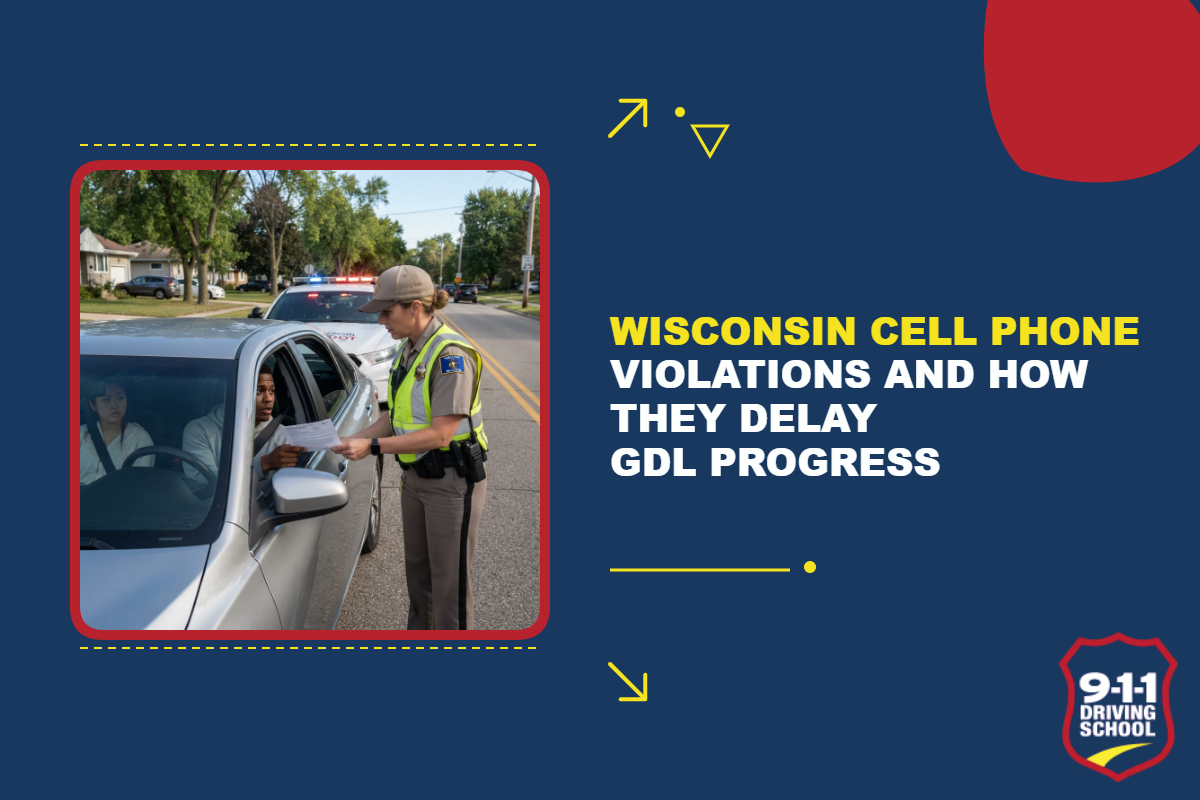
Wisconsin cell phone violations and how they delay GDL progress
For a new Wisconsin driver, a cell phone ticket can do more than create an expensive afternoon. It can slow down the path from instruction permit to probationary license, extend passenger and nighttime restrictions, add demerit points and create more stress for families trying to move through the graduated driver licensing process.
Wisconsin treats phone use seriously for drivers with an instruction permit or probationary license. The safest rule for new drivers is simple: when the vehicle is moving, the phone should be off, silent, out of reach or handled by a passenger.
This guide explains how Wisconsin cell phone violations affect GDL progress, what the law says, how penalties can stack up and what parents and teens can do to avoid preventable delays.
Why cell phone rules matter so much for new Wisconsin drivers
Wisconsin uses graduated driver licensing, often shortened to GDL, to give new drivers more experience before they receive full driving privileges. GDL restrictions limit some of the riskiest situations for teen drivers, including late-night driving and driving with multiple young passengers.
The state also places stricter phone rules on drivers who are still learning. According to the Wisconsin DMV cell phone rules for new drivers, using a cell phone while driving is against the law for any driver with an instruction permit or probationary license, except to report an emergency. The same page explains that the rule applies to both handheld and hands-free operation.
That point matters because many families assume the law only bans texting. For permit holders and probationary drivers, the rule is broader. A hands-free call, Bluetooth conversation or quick interaction with the phone can still create legal and licensing problems.
The basic Wisconsin rule: no phone use with an instruction permit or probationary license
Under Wisconsin law, a driver who holds an instruction permit or probationary license may not drive while using a cellular or other wireless telephone unless the driver is reporting an emergency. The underlying law appears in Wisconsin Statute 346.89 on inattentive driving, and the DMV summarizes the rule for families on its official teen-driver pages.
The rule applies to all instruction permit and probationary license holders. It is not limited to drivers under age 18. A 19-year-old new driver with a probationary license is still subject to the phone restriction while driving.
For a new driver, the practical rule is clear:
- Do not make a phone call while driving.
- Do not answer a phone call while driving.
- Do not use Bluetooth or hands-free calling while driving.
- Do not read or send texts while driving.
- Do not check notifications, maps, music, social media or messages while driving.
- Do not hold the phone at a red light and assume it is safe or legal.
Set directions, music and do-not-disturb settings before shifting out of park. If something has to change, the new driver should pull over in a safe and legal location before touching the phone.
Texting is illegal for every driver in Wisconsin
Wisconsin has a separate texting rule that applies to all drivers. The DMV states that texting while driving is against the law for every Wisconsin driver, not just drivers in the GDL system.
For new drivers, that means there are two layers to understand. First, texting while driving is illegal for everyone. Second, drivers with an instruction permit or probationary license face the stricter rule that bans cell phone use while driving, except to report an emergency.
A full-license adult may look at the issue as a texting rule. A Wisconsin permit holder or probationary driver should treat it as a no-phone rule.
What counts as a risky phone habit for a GDL driver?
A common problem for new drivers is trying to draw a line between phone uses that feel important and phone uses that are clearly distractions. That approach can get a teen into trouble. The better approach is to remove the decision entirely.
A Wisconsin permit holder or probationary driver should avoid the following while driving:
- Answering a parent, friend, coach or employer.
- Using speakerphone or earbuds for a call.
- Using a smartwatch to read or respond to messages.
- Changing a playlist or podcast from the phone screen.
- Entering or changing a route in a navigation app.
- Checking a weather alert, sports score or social media notification.
- Taking a photo or video from the driver seat.
- Holding the phone in stopped traffic or at a light.
Some of these actions may seem minor, but they pull attention away from the road at exactly the time a new driver needs maximum focus. New drivers are still building judgment, scanning habits, lane control and speed control. Adding a phone makes those skills harder to manage.
The emergency exception is narrow
Wisconsin allows phone use by an instruction permit or probationary driver when the driver is reporting an emergency. That exception should be treated narrowly.
Examples of true emergency situations may include:
- Reporting a crash.
- Calling 911 for a medical emergency.
- Reporting a dangerous driver.
- Reporting a road hazard that could cause a crash.
- Requesting help when the vehicle is disabled in a dangerous location.
Normal family logistics are not emergencies. A late pickup, change in dinner plans, missed turn or parent asking where the teen is located should wait until the driver is parked safely.
Parents can help by making one family rule: if the teen is driving, they do not answer. That protects the teen from pressure and makes it easier to follow the law consistently.
How a cell phone violation can delay GDL progress
Wisconsin GDL progress depends on clean driving time. A cell phone violation can interrupt that progress in different ways depending on whether the driver has an instruction permit or a probationary license.
If the driver has an instruction permit
A driver with an instruction permit who receives a cell phone ticket may have to wait six months from the date of the violation before becoming eligible for a probationary license. The Wisconsin DMV cell phone guidance specifically says that if a ticketed driver has an instruction permit, the driver must wait six months from the date of violation to be eligible for a probationary license.
That can be a major setback because teen drivers already need to satisfy several requirements before moving from permit to probationary license. The Wisconsin teen driver requirements explain that a teen generally must be at least 16, hold the instruction permit for at least six months, have no violations within the past six months, complete driver education and log at least 50 hours of supervised driving, including 10 hours at night.
In practical terms, a phone ticket can restart the violation-free waiting period. A teen who was close to taking the road test may have to push the timeline back, keep practicing under permit restrictions and wait before becoming eligible again.
If the driver has a probationary license
A probationary driver under GDL restrictions can also lose progress. Wisconsin DMV says that if a ticketed driver has a probationary license, is under GDL restrictions and the phone ticket is the only ticket the driver has received, the GDL restrictions will be extended six months.
That means a phone violation can turn the first nine months of restricted driving into a longer period of restricted driving. For many families, the most noticeable impact is that the teen remains under passenger and night-driving limits longer than expected.
If it is a second or later ticket
The consequences can become more serious when a new driver has more than one moving violation. The DMV explains that demerit points double on second and subsequent convictions for drivers with an instruction permit or probationary license. The Wisconsin point system also explains that point totals can lead to a suspension when enough points accumulate within a 12-month period.
A phone ticket should never be treated as a small issue for a new driver. It may affect the GDL timeline, the family schedule, insurance discussions and the teen’s ability to drive independently.
Which Wisconsin GDL restrictions can be extended?
Wisconsin GDL restrictions for drivers under 18 generally apply during the first nine months after the probationary license is issued or until the driver turns 18, whichever occurs first. The state explains these restrictions in the Wisconsin GDL FAQs and in its instruction permit, probationary license and regular license comparison.
During the restricted period, the driver has more freedom from 5 a.m. to midnight than from midnight to 5 a.m., but passenger limits still apply.
Passenger limits during the restricted period
From 5 a.m. to midnight, a teen probationary driver can drive alone and go where they need to go, but passenger limits apply. Wisconsin DMV explains that any number of immediate family members may ride along, and the driver may also have one other person or a qualified adult passenger who meets the state requirements.
A phone violation can extend the time that these passenger limits apply. That can affect school transportation, sports schedules, work shifts and social plans.
Night-driving limits during the restricted period
From midnight to 5 a.m., a teen probationary driver may drive alone only when traveling between home, school and work. For other trips during those hours, the driver must have a parent, guardian or other qualified licensed person seated in the front passenger seat.
When a cell phone violation extends GDL restrictions, those night-driving limits can also last longer. This is one of the most important consequences for families to understand before a teen starts driving independently.
How points can make the problem worse
Wisconsin DMV describes a cell phone violation for a permit or probationary driver as a four-point inattentive driving ticket plus a fine. Points matter because they are attached to the driving record and can contribute to a suspension if enough accumulate.
Under the Wisconsin driver license point system, courts report traffic convictions to DMV, and the driver’s license type helps determine how many points are assessed. Drivers with an instruction permit or probationary license receive double demerit points on second and subsequent convictions, except for certain equipment violations.
The point system page also explains that for drivers with a probationary license, instruction permit or no license, accumulating 12 to 30 points within 12 months results in a six-month suspension. More than 30 points within 12 months results in a one-year suspension.
This is why a family should not look at a phone ticket in isolation. One ticket may extend GDL restrictions. Another moving violation can double points and move the driver closer to suspension.
A phone violation can affect the road-test timeline
For a teen with an instruction permit, a clean six-month period is part of the road-test eligibility process. The Wisconsin probationary driver license requirements state that a Wisconsin resident under 18 must have held an instruction permit for at least six months and must have been violation free for six months before obtaining a probationary license.
That means a cell phone ticket is not just a conduct issue. It can directly interfere with scheduling the road test or applying for the probationary license. If the family has already planned around a license date, a violation can change that schedule quickly.
Families should also remember that citations may not appear instantly in every system. A pending ticket can still create problems when the court reports a conviction. When in doubt, check the teen’s DMV status, speak with the court listed on the citation and confirm eligibility before scheduling or relying on a planned road-test date.
Work zones and emergency scenes add another phone rule
Wisconsin also has specific phone restrictions in certain work and emergency areas. The Wisconsin emergency response area safety guidance explains that drivers cannot use a handheld phone while passing through a highway maintenance or construction area, utility work area, emergency response area or roadside response area, except to report an emergency.
The state also reminds drivers through its Wisconsin work zone cell phone safety page that handheld mobile device use is illegal in Wisconsin road work zones.
There is an important distinction for new drivers. In some work zone or emergency response situations, hands-free use may be allowed for full-license drivers. However, permit holders and probationary drivers are still under the stricter no-phone rule. For a new driver, the safer and simpler answer is the same everywhere: put the phone away.
Common myths about Wisconsin cell phone violations
Myth 1: hands-free calling is allowed because I am not holding the phone
For permit holders and probationary drivers, this is not a safe assumption. Wisconsin DMV says the cell phone law for these drivers applies to handheld and hands-free operation. A Bluetooth call can still be a problem.
Myth 2: the rule only applies to teens
The DMV specifically says the cell phone rule applies to all drivers with a probationary license or instruction permit, not just drivers under 18. A new adult driver with a probationary license should also avoid phone use while driving.
Myth 3: a quick text at a red light is harmless
A red light is still part of the driving environment. The signal can change, pedestrians may enter the crosswalk, emergency vehicles may approach and traffic around the vehicle may shift. A new driver should not use stopped traffic as a reason to pick up the phone.
Myth 4: one ticket only means paying a fine
For GDL drivers, one phone ticket can also extend restrictions, restart a violation-free period or add points. The DMV’s GDL pages make clear that violations can affect the restriction period and license progress.
Myth 5: parents can call because it is important
Parents should assume the teen will not answer while driving. If the message is urgent but not an emergency, send it and wait. If it is a true emergency, the teen should pull over safely before responding or call 911 if needed.
What parents should do before a teen drives alone
A phone plan should be part of every parent-teen driving agreement. Wisconsin DMV points families toward supervised practice tools, including the Wisconsin Motorists’ Handbook and driver-safety resources, but the family should also create rules that match how the teen actually uses technology.
Before the first solo drive, parents and teens should agree to the following:
- The phone goes on silent, do-not-disturb or driving mode before the vehicle moves.
- The phone stays in a bag, glove box, center console or mounted location where the driver will not touch it.
- Navigation is entered before leaving.
- Music or podcasts are selected before leaving.
- Parents do not call or text expecting an immediate response.
- If plans change, the teen pulls over somewhere safe before responding.
- Passengers are allowed to help with calls, texts and directions.
- Any ticket, stop or warning must be reported to a parent or sponsor immediately.
The point is not to punish the teen. The point is to remove decision-making pressure during the drive. New drivers should not have to decide whether a message is important enough to risk a ticket, crash or GDL delay.
A simple phone setup for new Wisconsin drivers
A good phone setup is boring, repeatable and easy to follow. Families can use this routine before every trip:
- Parked vehicle: enter the destination, start the route and set volume.
- Before shifting into drive: turn on do-not-disturb or driving focus mode.
- Put the phone where it will not be handled while driving.
- Tell parents or friends that replies will wait until the car is parked.
- If a call or message cannot wait, pull over safely and stop before using the phone.
- After parking: respond, adjust the route or change audio before driving again.
Parents should model the same behavior. A teen is more likely to follow the rule when the adults in the car put their phones down too.
What to do if a Wisconsin new driver receives a cell phone ticket
A family should take a cell phone citation seriously from the beginning. The exact legal outcome depends on the citation, the court, the driver’s record and the final conviction, so families should not rely on guesses.
A practical response includes:
- Read the citation carefully and note the court, deadline and listed violation.
- Tell the parent, guardian or adult sponsor immediately.
- Do not miss the court deadline or payment deadline.
- Check whether the citation may affect road-test eligibility, GDL restrictions or point totals.
- Use the official DMV page to check Wisconsin driver license status and details when needed.
- Ask the court or DMV how the conviction affects the driving record if anything is unclear.
- Create a new phone plan before the driver gets back behind the wheel.
If points become part of the issue, families can review the state’s Wisconsin traffic safety course information. DMV explains that drivers who successfully complete an approved traffic safety course may be able to request a three-point reduction, subject to state limits. This should not be treated as a substitute for safe driving, but it is useful to know where the official information is located.
How to talk to teens about phone violations without turning it into a lecture
Most teens already know texting while driving is dangerous. What they may not understand is how fast a small phone habit can affect their license progress. Parents can make the conversation more effective by connecting the rule to specific consequences.
Instead of saying only, “Do not use your phone,” explain what is at stake:
- A permit holder may have to wait longer before becoming eligible for a probationary license.
- A probationary driver may stay under GDL restrictions longer.
- A phone ticket can add points.
- A second or later moving violation can cause points to double.
- Enough points can result in suspension.
- A distracted-driving crash can harm the teen, passengers, pedestrians or another family.
That conversation is more concrete than a general warning. It helps the teen understand that the phone rule is not just about avoiding a fine. It is about keeping independence once they earn it.
Frequently asked questions about Wisconsin cell phone violations and GDL progress
Can a Wisconsin permit holder use a cell phone while driving?
No, except to report an emergency. Wisconsin DMV says cell phone use while driving is against the law for any driver with an instruction permit, and that the rule applies to handheld and hands-free operation.
Can a Wisconsin probationary driver use hands-free calling?
No, not while driving, except to report an emergency. The DMV states that the cell phone rule for instruction permit and probationary license holders applies to hands-free use as well as handheld use.
Does the Wisconsin new-driver phone rule apply only to teens?
No. The rule applies to drivers with an instruction permit or probationary license, not just drivers under age 18.
What happens if a permit holder gets a cell phone ticket?
Wisconsin DMV says a ticketed driver with an instruction permit must wait six months from the date of violation to be eligible for a probationary license. For teens, that can delay the road-test and licensing timeline.
What happens if a probationary driver gets a cell phone ticket?
If the driver has a probationary license, is under GDL restrictions and the phone ticket is the only ticket received, DMV says the GDL restrictions will be extended six months.
How many points is a Wisconsin cell phone violation for a new driver?
Wisconsin DMV describes the violation as a four-point inattentive driving ticket plus a fine. Points can double on second and subsequent convictions for drivers with an instruction permit or probationary license.
Can a new driver use the phone for GPS?
The safest answer for a Wisconsin permit holder or probationary driver is to set navigation before driving and avoid touching the phone while the vehicle is moving. If the route needs to change, pull over safely before using the phone.
Can a passenger use the driver’s phone?
A passenger can help with calls, texts, navigation or music so the driver can keep both hands and attention on the driving task. The driver should still avoid handling or interacting with the phone while driving.
Can parents text a teen while the teen is driving?
Parents can send a message, but they should not expect the teen to read it or respond while driving. A better family rule is that the teen responds only after parking safely.
Can a traffic safety course remove the delay?
A traffic safety course may help with point reduction in certain situations, but families should not assume it removes a GDL delay or court requirement. Review official DMV guidance and ask DMV or the court when the impact of a specific citation is unclear.
Final checklist for Wisconsin new drivers
Before every drive, a Wisconsin permit holder or probationary driver should:
- Set navigation before leaving.
- Turn on silent mode, do-not-disturb or driving focus mode.
- Put the phone away before the vehicle moves.
- Avoid calls, texts, Bluetooth conversations and app use while driving.
- Ask a passenger to handle the phone when appropriate.
- Pull over safely before using the phone for anything other than reporting an emergency.
- Stay especially alert in work zones and emergency response areas.
- Tell a parent or sponsor immediately about any citation, warning or stop.
- Review the Wisconsin Motorists’ Handbook and official DMV teen-driver pages as part of ongoing practice.
Wisconsin cell phone violations can delay GDL progress because they affect the very thing new drivers need most: clean, violation-free driving time. A permit holder may have to wait longer before becoming eligible for a probationary license. A probationary driver may remain under GDL restrictions longer. A second or later ticket can also create point problems that put driving privileges at risk.
The solution is simple but requires consistency. New drivers should not use a phone while driving. Parents should stop expecting immediate responses. Families should set the route, silence the phone and make safe driving the only task behind the wheel.
For Wisconsin teens, that habit protects more than a license timeline. It protects passengers, other drivers, roadside workers and the teen driver who is still learning how to make safe decisions on the road.