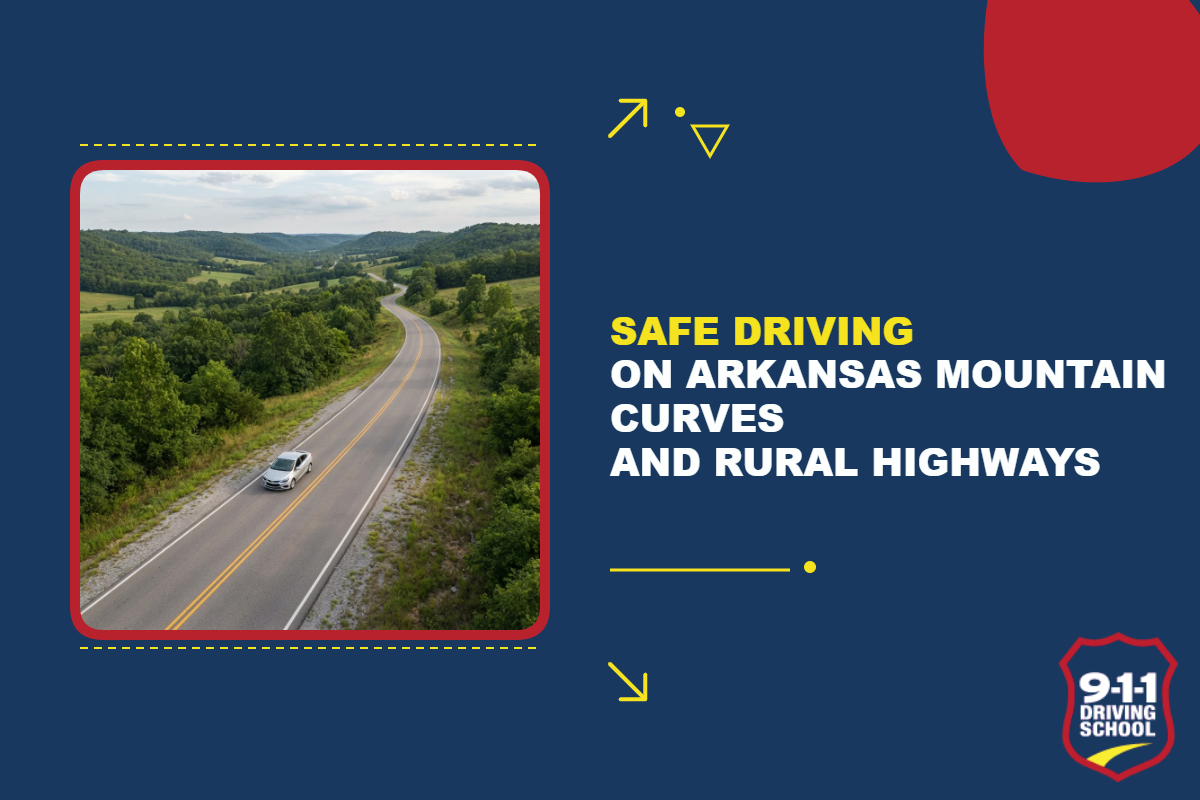
Safe driving on Arkansas mountain curves and rural highways
Arkansas is a great state for learning how to handle real-world driving conditions. New drivers may practice on neighborhood streets, school routes and city roads, but many Arkansas families also drive on two-lane rural highways, wooded roads, hill country routes and mountain curves. Those roads require a different kind of attention.
In northwest Arkansas, the Ozarks can bring steep grades, blind curves and narrow shoulders. In western and central Arkansas, the Ouachita Mountains can create winding roads, changing elevations and limited sight distance. Across the state, rural highways may include farm entrances, gravel shoulders, wildlife, slow-moving vehicles, trucks, motorcycles, bicycles and intersections that appear quickly after a hill or curve.
For a new driver, the biggest mistake is treating every rural road like a normal straight road. The posted speed limit is not a promise that every curve can be taken at that speed. The official Arkansas Driver License Study Guide explains that drivers must adjust speed to road and traffic conditions, slow down before curves and drive at a speed that allows them to stop within the distance they can see.
This guide explains how to approach Arkansas mountain curves and rural highways with more control, better judgment and safer habits. It is written for new drivers, parents and instructors who want to build confidence without turning rural driving into guesswork.
Why Arkansas rural roads deserve their own practice plan
Rural driving can feel easier at first because there may be less traffic. That feeling can be misleading. Rural roads often give drivers fewer visual cues, fewer streetlights, less shoulder space and less time to react when something appears around a bend. Speeds are usually higher than neighborhood speeds, and help may be farther away if a crash or breakdown occurs.
The Arkansas Highway Safety Office High Five Rural Project points out that rural road safety is a major issue in the state. The project notes that a large share of fatal crashes in Arkansas have occurred on rural roads, and it identifies loss of control, lane departure, excessive speed and failure to yield as common contributing factors in rural crashes.
Those are exactly the problems a new driver must learn to prevent on mountain curves and rural highways. A driver who enters a curve too fast may drift across the centerline, run off the pavement or panic-brake in the turn. A driver who assumes a rural intersection is empty may miss a pickup, tractor, motorcycle or logging truck approaching from a hidden driveway or crossroad.
A good practice plan should include more than parking and traffic-light skills. It should include curve speed, sight distance, following distance, passing decisions, rural intersections, weather changes and safe communication with other road users.
Start with official Arkansas driving resources
Before a new driver practices on rural highways, families should review Arkansas sources that explain the rules and safety expectations. The Arkansas State Police driver examination resources provide access to official study materials used for the written test and driver licensing process.
The most important resource for this topic is the Arkansas Driver License Study Guide. It covers safe speed, curves, hills, stopping distance, passing, lane markings, following distance, rural visibility problems, sharing the road with trucks and preparing for the skills test.
For longer drives, mountain trips or routes with possible weather issues, drivers should also check Arkansas Department of Transportation traveler information and IDrive Arkansas road conditions. Those resources can help families look for construction, closures, traffic incidents, flooding, winter weather and other conditions that may affect a rural route.
New drivers should understand that safe driving begins before the vehicle leaves the driveway. A short route check can prevent a teen from meeting a closed road, flooded low-water area, icy bridge or work zone for the first time without preparation.
Read the road before you enter a curve
Mountain curves require a driver to look farther ahead than the hood of the vehicle. A curve is not just a bend in the road. It is a place where sight distance, traction, lane position and speed all matter at the same time.
The Arkansas manual teaches that a vehicle can travel faster in a straight line than it can in a curve. It also warns that traveling too fast around a curve can cause the tires to lose grip and the vehicle to skid. The safest habit is simple: slow down before the curve so you do not have to brake hard while turning.
Before entering a curve, a new driver should quickly read several clues:
- The curve warning sign or advisory speed sign
- The direction and sharpness of the curve
- Whether the curve continues longer than expected
- The slope of the road before and through the turn
- The condition of the pavement
- The presence of gravel, leaves, water, snow, ice or mud
- The width of the lane and shoulder
- Any guardrails, drop-offs or ditches
- Oncoming traffic near or over the centerline
- Driveways, trailheads, farm entrances or scenic pull-offs near the curve
Parents and instructors should teach new drivers to say out loud what they notice. For example: “sharp right curve, downhill, no shoulder, possible gravel.” This turns a vague warning into a driving decision.
Slow down before the curve, not in the middle of it
One of the most important mountain driving habits is to reduce speed before the curve begins. Braking hard inside a curve can shift vehicle weight, reduce tire grip and make a skid more likely. This is especially true when the road is wet, shaded, covered with leaves or bordered by loose gravel.
Use this simple sequence:
- Look ahead and identify the curve early.
- Check the rearview mirror before slowing.
- Ease off the accelerator.
- Brake smoothly before the curve.
- Enter the curve at a speed that feels controlled.
- Look through the curve toward where you want the vehicle to go.
- Maintain a steady lane position.
- Accelerate gently only after the vehicle begins to straighten.
A new driver should not try to “save time” by entering a blind curve fast and correcting later. A safe curve speed is the speed that allows the driver to stay in their lane, react to a surprise and stop within the distance they can see.
Use the four-second sight distance rule
Sight distance is one of the most useful concepts for Arkansas mountain roads. If a driver cannot see far enough ahead to stop safely, the driver is going too fast for that situation, even if the vehicle is under the posted speed limit.
The Arkansas Driver License Study Guide explains the four-second sight distance rule. The idea is to pick a stationary object as far ahead as you can clearly see and count four seconds. If you reach that object before finishing the count, you need to slow down.
This rule is especially helpful on:
- Blind hill crests
- Curves with trees or rock faces near the road
- Roads with fog or heavy rain
- Unlit rural highways at night
- Roads with hidden driveways or field entrances
- Mountain roads where the pavement drops away after a turn
- Routes with wildlife activity
New drivers should practice the rule at moderate speeds first. The goal is not to stare at a sign and forget everything else. The goal is to build the habit of matching speed to visible stopping distance.
Keep your lane position steady through mountain curves
On rural roads, even a small lane-position error can create a serious risk. A driver who cuts across the centerline on a left curve may meet an oncoming vehicle. A driver who drifts to the right on a sharp curve may drop a tire off the pavement or hit gravel near the shoulder.
New drivers should look where they want the vehicle to go, not at the guardrail, ditch or oncoming vehicle. The hands tend to follow the eyes. Looking through the curve helps the vehicle track through the lane more smoothly.
Good lane control on curves includes:
- Keeping both hands on the wheel
- Avoiding sudden steering inputs
- Staying centered in the lane
- Leaving space from the centerline on blind curves
- Leaving space from the shoulder on curves with drop-offs or loose gravel
- Avoiding distractions before and during the curve
- Waiting until the vehicle is straight before adjusting the radio, phone mount or climate controls
If a new driver consistently crosses the centerline or runs wide in curves, the problem is usually speed. Slow the practice session down and rebuild the habit at a safer pace.
Do not pass near hills and curves
Passing on a two-lane rural highway is one of the highest-risk decisions a new driver can make. On a straight, flat road with clear markings, passing may be legal and safe when there is enough distance. On a mountain road, that same decision can become dangerous very quickly.
The Arkansas manual explains that at 55 mph a driver needs about 10 seconds and more than 1,600 feet, or about one-third of a mile, to pass safely. It also says drivers should not pass within one-third of a mile of a hill or curve and should assume an oncoming vehicle could be hidden beyond the curve or crest.
A new driver should not pass when:
- A curve is ahead
- The road rises toward a hill crest
- The centerline or signs prohibit passing
- A driveway, side road or field entrance is nearby
- A railroad crossing is ahead
- The shoulder is narrow or broken
- Rain, fog, dust or darkness limits visibility
- There is not enough space to return to the lane safely
- The vehicle ahead is turning or slowing for a hidden reason
Parents should be direct about this rule: if there is any doubt, do not pass. Waiting behind a slower vehicle is safer than guessing what might be around a blind curve.
Handle downhill grades with smooth speed control
Downhill mountain curves can surprise new drivers because the vehicle gains speed even when the driver is not pressing the accelerator. That extra speed can appear just as the road bends, the lane narrows or another vehicle approaches.
The safest habit is to set the speed before the grade becomes steep. Ease off the accelerator early and brake smoothly before the curve. Avoid riding the brakes constantly for a long downhill section because brakes can heat up and lose effectiveness.
Drivers should also avoid using cruise control on winding or slick mountain roads. Cruise control can keep adding speed or throttle when the driver should be preparing to slow down. A new driver needs full attention and direct control of speed on downhill curves.
When descending a rural grade:
- Look farther ahead than normal.
- Reduce speed before the curve begins.
- Keep extra following distance.
- Avoid hard braking in the middle of the turn.
- Watch for vehicles crossing the centerline uphill or downhill.
- Be ready for trucks, trailers and motorcycles to need more space.
- Do not coast in neutral.
Approach uphill curves and blind crests carefully
Uphill driving creates a different problem: limited sight distance. A new driver may not see a stopped vehicle, animal, cyclist, tractor, driveway or oncoming vehicle until the vehicle reaches the top of the hill or rounds the curve.
The Arkansas manual warns that drivers may not know what is on the other side of a hill or around a curve and should be ready to stop. That advice fits rural Arkansas driving very well.
When approaching a blind hill crest, keep to the right side of the lane without crowding the shoulder. Do not move left to see around the hill. Do not pass. Do not assume the lane ahead is clear.
New drivers should also be careful about stopping just beyond a hill crest. If a stop is necessary because of a breakdown, animal or obstruction, use hazard lights and move as far out of the travel lane as safely possible. Other drivers may have very little time to see a stopped vehicle over a hill.
Expect rural intersections to be hidden
Rural intersections do not always look like city intersections. Some have stop signs. Some have only a side road, gravel entrance, farm driveway or mailbox cluster. Some may sit just beyond a curve or hill. Others may have trees, brush, crops, ditches or parked equipment limiting the view.
The Arkansas manual reminds drivers that crossing traffic requires a large gap and that a driver should not begin across an intersection until traffic is clear. On rural roads, that means slowing early enough to actually look.
At rural intersections, new drivers should:
- Look for warning signs, road names, mailboxes and side-road openings.
- Check left, right and ahead before entering or crossing.
- Come to a full stop where required.
- Avoid rolling stops.
- Pause long enough to see around trees, fences, brush or parked vehicles.
- Watch for fast-moving traffic that may be closer than it appears.
- Be cautious around gravel roads because vehicles may need more room to stop.
- Never assume another driver sees you.
Rural intersections are a good place for parents to teach “look twice” habits. A small motorcycle, ATV, farm truck or pickup can be difficult to judge against a wooded or open-field background.
Watch for trucks, trailers and farm equipment
Arkansas rural highways are used by more than passenger cars. New drivers may share the road with logging trucks, tractor-trailers, farm equipment, horse trailers, boat trailers, utility vehicles, road crews and large pickups pulling equipment.
The Arkansas Driver License Study Guide explains that tractor-trailers take longer to stop, have larger blind spots and require more room to turn than passenger vehicles. The manual also warns drivers not to linger beside a truck and not to cut into the truck driver’s safety cushion.
On mountain curves and rural highways, that advice is even more important because large vehicles may need extra space. A trailer can swing wide. A truck may move closer to the centerline before a curve. A slow tractor may be just over the hill.
New drivers should:
- Increase following distance behind large vehicles.
- Stay out of truck blind spots.
- Never cut sharply in front of a truck or trailer.
- Avoid passing near hills, curves, intersections or driveways.
- Watch for wide turns.
- Give farm equipment time and space to turn.
- Be patient when a slow vehicle cannot safely move over.
If a slow vehicle is ahead, wait for a long, clear, legal passing area. A new driver should not let frustration turn into a rushed pass.
Adjust for rain, fog, leaves and shaded pavement
Mountain and rural roads can change traction quickly. One curve may be dry and the next may be shaded, damp or covered with leaves. A low area may hold fog. A bridge may be slick before the road around it. A storm may wash gravel or mud onto the pavement.
The Arkansas manual tells drivers to reduce speed when road conditions become unsafe and to adjust for slippery roads, water over the roadway and limited visibility. It also notes that speed limits are posted for ideal conditions and that drivers must slow down when weather, visibility or traffic conditions require it.
New drivers should watch for:
- Wet leaves on curves
- Mud or gravel washed across the lane
- Standing water in low places
- Fog in valleys
- Shaded pavement that may stay wet or icy
- Debris after storms
- Loose gravel near the shoulder
- Branches, rocks or animals in the lane
If visibility drops suddenly because of fog or heavy rain, slow down gradually, turn on the appropriate lights and increase following distance. If you cannot see the road ahead clearly, find a safe place to pull off and wait for conditions to improve.
Be careful with gravel shoulders and pavement edges
Many rural highways have narrow shoulders, soft edges or gravel beside the pavement. A new driver who drifts right may feel the tire drop off the pavement and panic. The wrong response is to jerk the wheel sharply back onto the road. That can send the vehicle across the lane or into oncoming traffic.
If a tire leaves the pavement edge:
- Stay calm and keep a firm grip on the wheel.
- Ease off the accelerator.
- Do not slam the brakes.
- Keep the vehicle moving as straight as possible.
- Allow speed to drop.
- Check traffic.
- Steer gently back onto the pavement when the edge is low enough and the lane is clear.
Parents should practice this concept verbally before any rural drive. A teen who has heard the steps before is more likely to respond calmly if it happens.
Use the right following distance on rural highways
Following distance is not only a city traffic issue. It matters even more on rural roads because curves, hills and changing surfaces can reduce reaction time. If a vehicle ahead brakes for a deer, tractor, driveway or stopped school bus, a tailgating driver may have nowhere to go.
The Arkansas manual teaches the two-second rule as a basic way to check following distance and explains that some situations require more space. Slippery roads, poor visibility, motorcycles, trucks and vehicles that block your view all call for a larger safety cushion.
New drivers should increase following distance when:
- The road is wet, icy or covered with gravel.
- A curve or hill limits visibility.
- Following a truck, bus, trailer or farm vehicle.
- Driving at night.
- Dust, fog or rain limits visibility.
- Wildlife is likely.
- Traffic is moving at highway speed.
- A driver behind you is following too closely.
When another driver tailgates, do not speed up beyond a safe pace. Maintain control, increase space ahead and let the other driver pass when it is legal and safe.
Prepare for wildlife and unexpected stops
Arkansas rural roads often pass through wooded areas, open fields and river valleys where animals may enter the roadway. Deer are most common at dawn, dusk and night, but drivers should also watch for dogs, livestock, raccoons, turkeys and other animals.
A new driver’s goal is to reduce the chance of a sudden swerve. Swerving at highway speed on a rural curve can cause loss of control, lane departure or a collision with an oncoming vehicle.
Use these habits:
- Scan the shoulders and ditches, not just the center of the lane.
- Slow down in areas with animal crossing signs or heavy woods.
- Use high beams when legal and safe to improve visibility.
- Watch for pairs or groups of animals.
- Brake firmly while keeping the vehicle in the lane if an animal appears.
- Avoid sudden swerves unless needed to avoid a more serious crash.
- Pull fully out of the travel lane before checking damage after a strike.
This is another reason curve speed matters. A driver who enters a curve at a controlled speed has more options when the unexpected appears.
Do not let scenic roads become distracted driving roads
Arkansas mountain roads can be beautiful, but scenery can become a distraction. New drivers may look toward a river, bluff, valley overlook, trailhead or lake instead of tracking the lane. Passengers may point things out at exactly the wrong time. Phones and navigation screens can add more distraction.
The Arkansas Highway Safety Office safety programs emphasize safe habits such as obeying speed limits, paying attention and avoiding risky driving behavior. For a new driver, that means setting navigation before leaving and letting a passenger manage music or directions when possible.
A simple family rule helps: enjoy the view from a safe pull-off, not from the driver’s seat in the middle of a curve.
Plan before longer mountain or rural trips
A new driver should not begin rural highway practice with the hardest route. Build skill gradually. Start with daylight, dry pavement and a familiar road. Add more challenging conditions only after the driver can maintain speed, lane position and calm decision-making.
Before a longer rural drive, check:
- Current travel conditions through IDrive Arkansas.
- Weather along the full route, not just at home.
- Fuel level and tire pressure.
- Headlights, brake lights and turn signals.
- Windshield wipers and washer fluid.
- Phone charge for emergencies, kept out of the driver’s hands.
- Whether daylight will last for the full practice route.
- Where safe pull-offs, rest areas or towns are located.
Parents should avoid turning a first rural drive into a long, tiring trip. Fatigue can reduce attention, reaction time and patience, especially on roads with constant curves.
Build a parent-and-teen practice plan
Safe rural driving is a learned skill. Parents should not wait until a teen is driving alone to introduce mountain curves, rural intersections and two-lane highways. Practice should be planned, supervised and progressive.
Practice session 1: observation and speed control
Choose a lightly traveled rural road in daylight and dry weather. Focus on reading signs, spotting curves early, checking mirrors before slowing and reducing speed before each turn. Keep the session short and calm.
Practice session 2: lane position on curves
Use a route with gentle curves before moving to tighter ones. Have the teen look through the curve and maintain a centered lane position. If the vehicle drifts, reduce speed and repeat easier curves before adding difficulty.
Practice session 3: hills and limited sight distance
Practice approaching hill crests and blind curves at a speed that allows the teen to stop if something appears. Talk through what might be hidden: an animal, cyclist, stopped car, tractor, driveway or oncoming vehicle.
Practice session 4: rural intersections and turns
Work on complete stops, left turns across traffic, gravel-road entrances and side roads with limited visibility. Teach the teen to look more than once before crossing or turning.
Practice session 5: two-lane passing judgment
Do not begin with actual passing. Start by identifying places where passing is clearly unsafe: hills, curves, intersections, driveways, no-passing zones, narrow shoulders and limited visibility. The goal is to build judgment before attempting the maneuver.
Practice session 6: weather and low-light awareness
Once basic control is consistent, add twilight, light rain or other manageable conditions with adult supervision. Avoid severe weather, heavy fog, ice or any situation that is beyond the driver’s current ability.
Common mistakes new drivers make on Arkansas mountain roads
Most mountain and rural driving mistakes come from speed, distraction, impatience or poor observation. The good news is that these mistakes can be corrected with focused practice.
Entering curves too fast
This is the most common problem. The driver feels comfortable on the straight section and does not slow early enough. By the time the curve tightens, the vehicle is already moving too fast. The fix is to brake before the curve and enter at a controlled speed.
Cutting the centerline
Crossing the centerline on a rural curve is dangerous because an oncoming vehicle may appear with no warning. The fix is to slow down, look through the turn and keep the vehicle centered in the lane.
Drifting onto the shoulder
A driver who looks at the edge of the road may drift toward it. Loose gravel, soft shoulders and drop-offs can make recovery harder. The fix is to look where the vehicle should go and make smooth steering corrections.
Passing because the driver feels pressured
A vehicle behind you may be impatient, but that does not make a pass safe. Do not pass near hills, curves, intersections or driveways. Let the impatient driver pass when it is safe rather than copying their behavior.
Following too closely behind trucks or slow vehicles
Tailgating blocks visibility and reduces reaction time. It also puts the driver in a poor position if the vehicle ahead brakes, turns or swerves. The fix is to fall back and create a better view of the road ahead.
Ignoring weather and surface changes
A road can change from dry to slick in one shaded curve. Leaves, rain, fog, gravel and mud all require lower speed and smoother control. The fix is to treat every curve as a new decision.
Vehicle checks before rural highway practice
A vehicle problem that is minor in town can become a serious issue on a rural highway. Before practice, the supervising adult should check the basics.
- Tire pressure and tread depth
- Headlights and high beams
- Brake lights and turn signals
- Windshield wipers
- Washer fluid
- Fuel level
- Mirrors and seat position
- Emergency contact information
- Phone battery
- Registration and insurance
Everyone in the vehicle should buckle up before the trip begins. The Arkansas Highway Safety Office occupant protection resources emphasize seat belt use as one of the most important protections for drivers and passengers.
Frequently asked questions about Arkansas mountain and rural driving
Should new drivers practice on Arkansas mountain roads?
Yes, but practice should be gradual and supervised. Start with easier rural roads in daylight and dry weather. Add sharper curves, hills, traffic, darkness or weather only after the driver has shown consistent control.
What is the safest way to drive through a curve?
Slow down before entering the curve, look through the curve, keep both hands on the wheel, stay centered in the lane and avoid hard braking while turning. Accelerate gently after the vehicle begins to straighten.
Is the posted speed limit always safe on a mountain curve?
No. The posted speed limit applies under ideal conditions. Curves, rain, fog, gravel, ice, darkness, traffic and limited sight distance may require a lower speed.
When should a new driver avoid passing on rural highways?
A new driver should avoid passing near hills, curves, intersections, driveways, railroad crossings, no-passing zones, narrow bridges and any area where the view is limited. If there is any doubt, wait.
What should a teen do if another driver is tailgating on a rural road?
Do not speed up beyond a safe pace. Keep a steady speed, increase space ahead and let the other driver pass when it is legal and safe. Do not brake-check or make sudden moves.
How can parents make rural driving practice safer?
Plan the route, check road and weather conditions, begin in daylight, keep the session short, give calm instructions and focus on one skill at a time. After the drive, review what went well and what needs more practice.
Final checklist for safe Arkansas rural highway driving
Before a new driver heads onto mountain curves or rural highways, review this checklist:
- Check the route and road conditions before leaving.
- Buckle every person in the vehicle.
- Set navigation before driving.
- Slow down before every curve.
- Use the four-second sight distance rule.
- Keep a steady lane position.
- Do not pass near hills, curves or intersections.
- Increase following distance behind trucks, trailers and farm equipment.
- Watch for wildlife, gravel, leaves, mud and standing water.
- Approach rural intersections as if another vehicle could appear suddenly.
- Avoid cruise control on winding or slick roads.
- Pull over safely if weather or visibility becomes too poor.
- Stay patient when stuck behind slower traffic.
Safe driving on Arkansas mountain curves and rural highways comes down to patience, observation and speed control. New drivers need to understand that rural roads are not automatically safer because they are less crowded. Curves can hide hazards. Hills can hide traffic. Gravel and rain can reduce traction. A slow vehicle can create pressure to pass before it is safe.
The best drivers adjust before conditions force them to react. They slow down before curves, leave extra space, avoid risky passes and expect the unexpected at rural intersections.
For parents, the goal is not to scare teens away from rural driving. The goal is to give them enough supervised practice that mountain roads and rural highways feel manageable. With the right habits, new drivers can enjoy Arkansas roads while respecting the risks that come with curves, hills, limited sight distance and changing conditions.