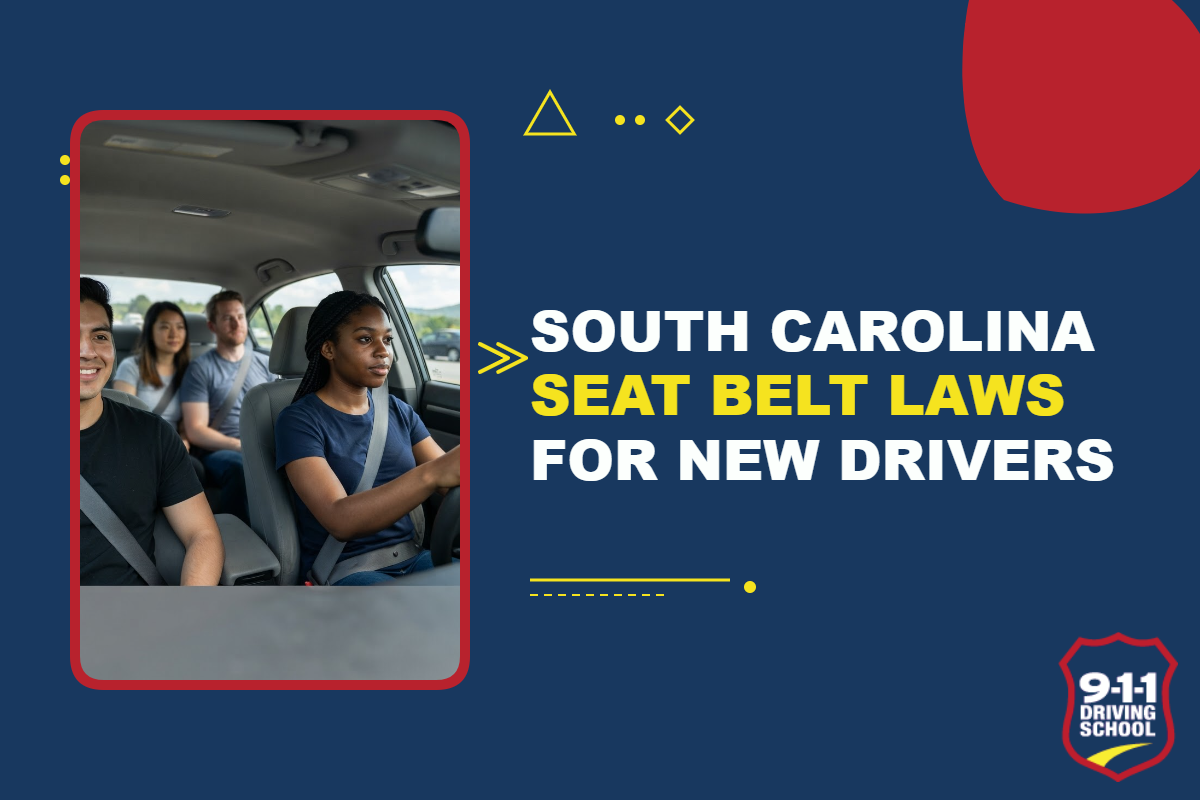
South Carolina seat belt laws for new drivers
Seat belt rules are one of the first traffic laws every new driver should understand. In South Carolina, buckling up is not just a safety recommendation. It is a legal requirement for the driver and every occupant when a motor vehicle is being operated on public streets and highways.
For a new driver, this matters before the car ever leaves the driveway. You are learning how to control the vehicle, manage passengers, follow licensing restrictions and make safe decisions at the same time. A seat belt check should become part of your routine before every trip.
The current South Carolina Code Section 56-5-6520 says the driver and every occupant of a motor vehicle must wear a fastened safety belt while the vehicle is operated on public streets and highways in the state. The South Carolina Department of Public Safety seat belt guidance also explains that South Carolina has a primary safety belt enforcement law.
This guide explains what new drivers need to know about South Carolina seat belt laws, how the rules apply to teen passengers, what penalties can apply, how child restraint rules fit into the picture and how to build a safe buckle-up habit every time you drive.
The quick answer
South Carolina law requires the driver and every occupant to wear a fastened safety belt. Law enforcement may stop a driver for a seat belt violation when the officer has a clear and unobstructed view that the driver or an occupant is not buckled or that a child is not secured as required.
- Every driver must buckle up.
- Every passenger must buckle up.
- The rule applies to the front seat and the back seat.
- A driver is generally responsible for passengers age 17 or younger unless the young passenger has a driver’s license, special restricted license or beginner’s permit.
- A seat belt violation is usually a civil fine, not a criminal offense.
- A seat belt violation does not add driver’s license points in South Carolina.
- Child passengers may need a car seat or booster seat instead of only an adult seat belt.
What South Carolina law requires
The main rule is simple: buckle up before the vehicle moves. Under South Carolina safety belt law, the driver and every occupant of a motor vehicle must wear a fastened safety belt when the vehicle is operated on public streets and highways.
This is especially important for new drivers because a seat belt violation can create a traffic stop, distract you before a trip and show that you have not built a complete pre-drive routine. Even if the fine is not large, the habit matters.
The law does not say that only the driver or front-seat passengers need to buckle up. It says every occupant. That includes friends in the back seat, siblings, adult passengers and anyone riding with a teen driver.
South Carolina has primary seat belt enforcement
South Carolina is a primary enforcement state for seat belts. The Buckle Up South Carolina campaign explains that a law enforcement officer may stop a driver when the officer has a clear and unobstructed view of a driver or occupant who is not wearing a safety belt or a child who is not secured in a child restraint system.
For new drivers, the practical lesson is direct: do not treat seat belts as something passengers can handle later. Check before backing out, before pulling away from a curb and before entering traffic.
Primary enforcement also means an officer does not need to observe another traffic violation first. If the seat belt violation is visible and the legal standard is met, the stop can begin with the seat belt issue.
Who is responsible when a passenger is not buckled?
A new driver should think about seat belt responsibility in two ways: everyone has a duty to buckle up, and the driver has extra responsibility for younger passengers.
Under South Carolina Code Section 56-5-6520, the driver is charged with the responsibility of requiring each occupant age 17 or younger to wear a safety belt or be secured in a child restraint system. There is an important exception: if that young occupant has a driver’s license, special restricted license or beginner’s permit, the occupant is the one in violation for not wearing a seat belt.
That legal detail can be confusing, so new drivers should use a simpler rule in real life: nobody rides unbuckled. It is safer, easier to remember and less likely to lead to a roadside problem.
What this means for teen drivers
Teen drivers often carry friends, siblings and classmates. That makes seat belt compliance part of passenger management. Before shifting into drive, tell everyone to buckle up. Do not let passengers make it a debate, and do not start driving while someone is still looking for the belt.
South Carolina teen drivers also need to follow licensing limits. The SCDMV teenage driver licensing page explains that conditional and special restricted license holders have passenger and nighttime driving restrictions. Those restrictions are separate from the seat belt law, but they work together. A teen driver must control who is in the vehicle and make sure each person is properly restrained.
South Carolina seat belt penalties
A person found in violation of South Carolina seat belt law may be fined not more than $25. The law also says a person may not be fined more than $50 for one incident involving one or more seat belt violations.
The penalty section of the South Carolina safety belt article also states that no court costs, assessments or surcharges may be assessed for a seat belt violation. It further says the violation is not a criminal offense and is not included in the offender’s motor vehicle records maintained by the Department of Motor Vehicles or reported to the offender’s motor vehicle insurer.
South Carolina law also provides that no driver’s license points may be assessed for a seat belt violation. For new drivers, that is good to know, but it should not make the rule feel optional. A seat belt stop can still be stressful, and the bigger issue is safety.
Can police search a vehicle just because of a seat belt violation?
The same state law says a vehicle, driver or occupant may not be searched, and consent to search may not be requested, solely because of a seat belt violation. This does not mean a seat belt stop cannot involve other lawful issues if an officer observes something else. It simply means the seat belt violation alone does not authorize a search.
Common seat belt exceptions
South Carolina law includes exceptions, but most new drivers will not fall into them during normal driving. According to the state code, the seat belt article does not apply to certain situations and vehicles, including a driver or occupant with written physician verification that the person is unable to wear a safety belt for physical or medical reasons, certain emergency medical or rescue personnel, school, church or day care buses, public transportation vehicles except taxis, parade occupants, United States mail carriers, occupants when no belt is available because all belts are being used and vehicles not originally equipped with safety belts.
A new driver should not try to rely on an exception unless it clearly applies. The safest approach is to use one working seat belt for each person in the vehicle and avoid carrying more people than the vehicle can safely seat.
How to wear a seat belt correctly
Knowing that seat belts are required is only part of the rule. New drivers also need to know how a seat belt should fit. The official SCDMV driver’s manual explains that a shoulder harness should be worn across the shoulder and chest with minimal slack. It should not be worn under the arm or behind the back.
The lap belt should be snug and lie low across the hips after fastening. A belt worn across the stomach, tucked behind the shoulder or held away from the body can fail to protect you properly in a crash.
Use this fit check every time:
- The shoulder belt crosses the center of the chest.
- The shoulder belt is not behind the back or under the arm.
- The lap belt sits low across the hips and upper thighs.
- The belt is snug, not twisted and not pinned behind the passenger.
- The seat back is upright enough for the belt to sit correctly.
- The passenger stays seated normally instead of leaning out of the belt.
Airbags do not replace seat belts
Some new drivers assume airbags are enough. They are not. The SCDMV driver’s manual section on safety belts and airbags explains that airbags are supplemental restraints and are designed to work best in combination with safety belts.
Seat belts help keep you in position so the airbag can protect you as intended. Without a seat belt, a crash can throw the driver or passenger out of position before the airbag deploys. Seat belts also help reduce the risk of being thrown from the vehicle.
Child passenger safety rules in South Carolina
New drivers may sometimes carry younger siblings, cousins or children they babysit. In those situations, ordinary adult seat belt rules may not be enough. South Carolina child passenger safety law requires children under age 8 to be properly secured in an appropriate child passenger restraint system.
The South Carolina child passenger safety guidance explains the basic stages: rear-facing car seat, forward-facing car seat, booster seat and then adult seat belt when the child is old enough or tall enough and the belt fits properly.
Rear-facing car seats
An infant or child under age 2 must be secured in a rear-facing child passenger restraint system in a rear passenger seat until the child exceeds the height or weight limit allowed by the manufacturer of the seat.
Forward-facing car seats
A child who is at least age 2, or a younger child who has outgrown the rear-facing seat, must be secured in a forward-facing child passenger restraint system with a harness in a rear passenger seat until the child exceeds the height or weight limits for that seat.
Booster seats
A child at least age 4 who has outgrown a forward-facing car seat must use a belt-positioning booster seat in a rear seat until the child can meet the height and fit requirements for an adult safety belt. South Carolina law requires the booster to be used with both lap and shoulder belts.
When a child can use an adult seat belt
A child who is at least age 8 or at least 57 inches tall may use an adult safety belt if the belt fits properly. Under the state code, proper fit means the lap belt fits across the child’s thighs and hips rather than the abdomen, the shoulder belt crosses the center of the chest rather than the neck and the child can sit with the back straight against the seat with knees bent over the seat edge without slouching.
When in doubt, use the correct child restraint and get help. The South Carolina Department of Public Health offers information about child passenger safety inspection stations, which can help families find a certified technician to check a car seat.
The back seat is safest for children
The South Carolina Department of Public Safety child passenger safety page states that the back seat is the safest place for children under age 13 to ride. A front passenger airbag is designed for adult protection in combination with a seat belt, not for small children.
A child under age 8 may be transported in the front seat only in limited circumstances, such as when the vehicle lacks a rear passenger seat or all rear seating positions are occupied by children under age 8, and the child must still be properly secured in the correct restraint.
Teen licensing rules and seat belt habits
Seat belt laws apply to all drivers, but South Carolina teen drivers have extra licensing rules that make passenger control even more important.
According to the SCDMV guide for teenage drivers, a conditional or special restricted license holder generally cannot have more than two passengers under 21 in the vehicle unless accompanied by a licensed adult who is at least 21. The main exceptions involve family members or students being transported to and from school.
That passenger limit is not the same as the seat belt law, but both rules point to the same habit: keep the vehicle under control before it moves. A new driver should know who is riding, where each person is sitting and whether every passenger is buckled correctly.
Beginner’s permit drivers
A driver with a South Carolina beginner’s permit must drive under supervision. Even when a supervising adult is in the front passenger seat, the permit holder should still practice the full driver routine: seat adjusted, mirrors adjusted, passengers buckled, doors closed and phone put away.
Conditional and special restricted license holders
A teen with limited unsupervised driving privileges may be responsible for managing passengers without a parent in the vehicle. This is when peer pressure can become a problem. A simple rule helps: if someone refuses to buckle up, the car does not move.
Adult new drivers
Adults who are new to driving still need the same habit. Before taking the road test or driving independently, practice buckling up automatically and checking passengers before moving. The SCDMV regular license testing page explains permit holding periods and road testing rules, but your day-to-day safety habits are built during practice.
A simple seat belt routine for every new driver
The easiest way to follow the law is to build seat belts into the same routine every time you start the vehicle.
- Sit in the correct driving position and adjust the seat.
- Fasten your own seat belt before starting to drive.
- Check that the lap belt is low and the shoulder belt crosses the chest.
- Ask every passenger to buckle up.
- Look or listen for each passenger belt to click.
- Make sure younger children are in the right car seat or booster.
- Make sure children under 13 are in the back seat when possible.
- Do not shift into drive or reverse until everyone is secured.
Common seat belt mistakes new drivers make
Starting the car before everyone is buckled
The best time to fix a seat belt problem is before the vehicle moves. If someone is still buckling while you are backing out, your attention is split between the passenger and the road.
Letting back-seat passengers skip the belt
South Carolina law requires every occupant to wear a fastened seat belt. Back-seat passengers are not exempt just because they are behind the driver.
Wearing the shoulder belt under the arm
A shoulder belt under the arm can place crash forces on the ribs, abdomen and internal organs. The shoulder belt should cross the shoulder and chest.
Putting the shoulder belt behind the back
Putting the shoulder belt behind the back removes upper-body restraint. That can allow the upper body to move forward violently in a crash.
Using an adult belt too soon for a child
A child who is too small for an adult belt may slide out of position or have the lap belt ride across the abdomen. Use the correct car seat or booster until the adult belt fits properly.
Carrying more people than the vehicle can safely seat
A crowded vehicle makes it harder to keep everyone restrained. New drivers should avoid transporting more people than there are safe seating positions and working seat belts.
Unbuckling before the vehicle is parked
Passengers sometimes unbuckle as soon as the vehicle enters a neighborhood, school parking lot or driveway. Keep seat belts fastened until the vehicle is fully stopped and parked.
Pickup truck beds and new drivers
A seat belt is built for a seated passenger inside the vehicle. Riding in an open cargo area is a different safety issue. The South Carolina seat belt laws page from SCDPS explains that state law prohibits transporting a person under age 15 in the open bed or open cargo area of a pickup truck or trailer unless a specific exception applies.
New drivers should avoid carrying passengers in cargo areas. Even when an exception exists, the safest choice is for every passenger to ride inside the vehicle in a proper seating position with the correct restraint.
How seat belts affect safe driving habits
Seat belts do more than reduce injury risk in a crash. They also help the driver stay in position during sudden braking or evasive steering. The South Carolina driver’s manual notes that safety belts help keep drivers from being thrown from the vehicle and help the driver keep control.
For new drivers, staying properly positioned is especially important. You are still developing steering control, braking judgment and scanning habits. A properly worn seat belt helps keep you centered behind the wheel if traffic changes quickly.
What parents should teach new drivers about seat belts
Parents and guardians can help new drivers by making seat belt use non-negotiable from the first supervised drive. The goal is not to lecture every time. The goal is to make buckling up automatic.
- Model the behavior by buckling up before the vehicle moves.
- Ask the teen driver to check passengers before shifting gears.
- Practice saying, “I cannot drive until everyone is buckled.”
- Review child restraint rules before allowing the teen to transport younger siblings.
- Remind the teen that passenger limits and seat belt rules are separate requirements.
- Do not allow extra passengers who do not have a safe seating position.
Seat belt checklist before every drive
- Driver buckled correctly.
- Front passenger buckled correctly.
- Back-seat passengers buckled correctly.
- Younger children in the correct car seat or booster.
- No shoulder belts behind backs or under arms.
- No lap belts riding across the stomach.
- No twisted or loose belts.
- No passenger sitting where there is no working seat belt.
- Vehicle stays parked until everyone is secured.
Frequently asked questions about South Carolina seat belt laws
Do back-seat passengers have to wear a seat belt in South Carolina?
Yes. South Carolina law requires the driver and every occupant to wear a fastened safety belt when the vehicle is operated on public streets and highways.
Can police pull you over only for a seat belt violation?
Yes. South Carolina has primary seat belt enforcement. An officer may stop a driver when the officer has a clear and unobstructed view that a driver or occupant is not wearing a safety belt or that a child is not secured as required.
How much is a seat belt ticket in South Carolina?
A seat belt violation can result in a fine of not more than $25. A person may not be fined more than $50 for one incident involving one or more violations.
Does a South Carolina seat belt ticket add points?
No. South Carolina law states that no driver’s license points may be assessed for a violation of the safety belt article.
Is a seat belt violation a criminal offense in South Carolina?
No. The safety belt penalty section states that a violation does not constitute a criminal offense.
Who gets the ticket if a teen passenger is not buckled?
The driver is generally responsible for requiring each occupant age 17 or younger to wear a seat belt or be secured in a child restraint system. However, if the young passenger has a driver’s license, special restricted license or beginner’s permit, that passenger is in violation for not wearing a seat belt.
When can a child use an adult seat belt in South Carolina?
A child who is at least age 8 or at least 57 inches tall may use an adult seat belt if the belt fits correctly. The lap belt should fit across the thighs and hips, the shoulder belt should cross the center of the chest, and the child should be able to sit against the seat back with knees bent over the seat edge without slouching.
Are airbags enough without a seat belt?
No. Airbags are supplemental restraint systems. They are designed to work with seat belts, not replace them.
Should new drivers check seat belts during the road test?
A new driver should always buckle up before driving, including during practice and testing. Passengers should also be properly restrained. A good pre-drive routine helps show that the driver is prepared, organized and safety focused.
South Carolina seat belt laws are straightforward: the driver and every occupant must buckle up. The law applies to new drivers, experienced drivers, front-seat passengers and back-seat passengers. For teen drivers, seat belt use also connects directly to passenger management and responsible driving habits.
The safest rule is simple: no belt, no ride. Check yourself, check your passengers and make sure children are in the correct restraint before the vehicle moves. That habit protects you legally, but more importantly, it protects everyone in the vehicle.